
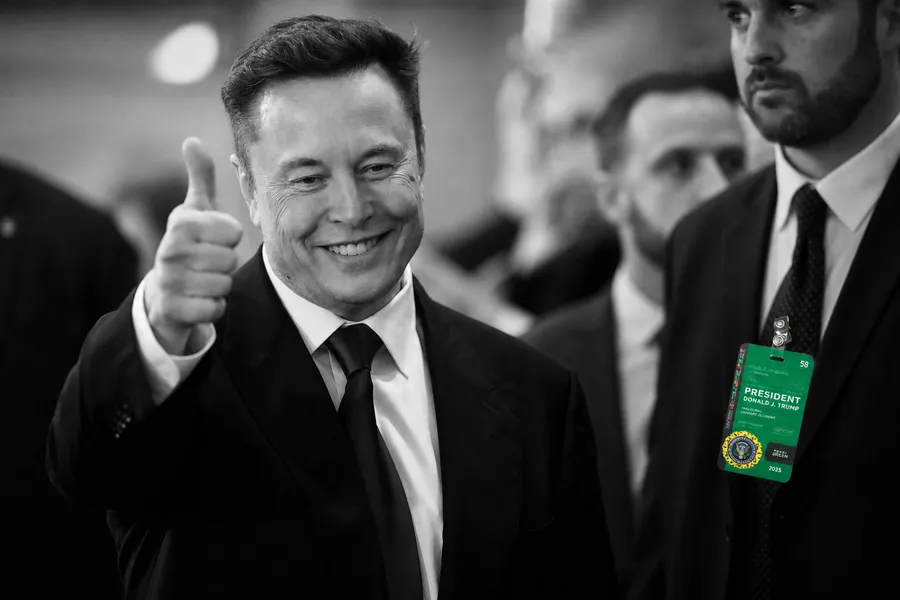
SpaceX (SPCX) began trading on the Nasdaq on Friday after raising a record $75 billion at IPO, vaulting founder Elon Musk past $1.1 trillion in net worth and reordering the global wealth landscape in a single session.
For macro and sector investors, the debut creates the largest new publicly traded aerospace and AI asset in history, with a valuation that analysts say will force immediate index rebalancing and redraw competitive dynamics across launch, satellite broadband, and space-based data infrastructure.
Key Takeaways
- SpaceX raised a record $75 billion at $135 per share at IPO.
- Musk’s net worth exceeds $1.1 trillion, a global first.
- SpaceX commands more than 80% of global rocket launches.
Market Reaction & Context
The $135-per-share IPO price implies a valuation approaching $1.8 trillion, instantly ranking SpaceX among the five largest publicly traded companies in the United States and dwarfing the combined market capitalisation of legacy launch rivals Boeing and Lockheed Martin 1. The offering was two times oversubscribed, according to sources cited by Reuters, underscoring institutional appetite despite the company’s net loss of $4.9 billion last year 1.
Prior to the share sale, Forbes estimated Musk’s fortune at roughly $780 billion, already nearly three times the wealth of the next richest individual 1. “The second richest person has been hovering around $300 billion, so about less than one-third of what Musk can potentially be worth tomorrow,” said Matt Durot, deputy editor at Forbes Wealth 1.
Detailed Analysis
SpaceX’s SpaceX stake alone accounts for approximately $866 billion of Musk’s calculated net worth, with Tesla (TSLA.O) and other holdings making up the remainder 1. Reuters calculations based on company filings, including stock components that vest over time, put the total above $1.1 trillion at the open of trading 1.
The company reported revenue of $18.7 billion last year, up more than 30%, driven largely by Starlink satellite internet, which generated $4.4 billion in profit 3. Those gains were offset by $6.4 billion in losses from xAI, the artificial intelligence unit embedded within the broader SpaceX structure 3.
SpaceX claimed more than 80% of global rocket launches last year and has more than 10,000 Starlink satellites in low Earth orbit, giving it unmatched launch cadence and a commercially mature broadband revenue stream 3. The company also holds top-tier contracts with NASA and the Pentagon, including a role in developing President Donald Trump’s proposed “Golden Dome” missile-defence shield 3.
Governance remains a focal point for institutional investors. The IPO structure preserves near-unchecked executive power for Musk, a feature that drew scrutiny but did not deter demand 3. Key early backers stand to realise enormous gains: hedge fund Darsana Capital Partners, which allocated roughly 60% of its assets under management to SpaceX, could see paper gains exceeding $10 billion, while D1 Capital Partners converted a roughly $600 million position into approximately $9 billion in paper profit 3.
Outlook & Analyst Quotes
Some analysts warn that the headline valuation stretches conventional metrics well beyond historical precedent. “Much like Tesla, SpaceX is a bet on Elon Musk,” said Matt Kennedy, senior strategist at Renaissance Capital. “A market cap of $1.5 trillion-$2 trillion would certainly throw all traditional valuation methodologies out the window, and is instead best characterised as the ‘Elon Musk premium'” 1.
Musk’s compensation structure includes up to 200 million additional Class B shares contingent on reaching a $7.5 trillion valuation and establishing a Mars colony of one million inhabitants, targets that most analysts consider generational in scope 3. A separate tranche of 60 million shares would vest if the company deploys space-based data centres with 100 terawatts of computing capacity 3.
Conclusion
SpaceX’s Nasdaq debut marks an inflection point for public-market exposure to commercial space and satellite infrastructure, sectors that until Friday were largely inaccessible to retail investors at scale. The cash-hungry nature of the business, combined with an unconventional governance structure and lofty valuation multiples, means the stock’s post-IPO trajectory will be closely watched as a barometer of investor risk appetite in the current macro environment.
Not investment advice. For informational purposes only.
References
1Manya Saini, Niket Nishant, Akash Sriram, Mike Colias (June 11, 2026). “SpaceX IPO makes Elon Musk the world’s first trillionaire”. Reuters. Retrieved June 12, 2026.
2(June 3, 2026). “SpaceX files for IPO in move that could make Elon Musk the world’s first trillionaire”. NBC News via YouTube. Retrieved June 12, 2026.
3Jason Ma (May 22, 2026). “Musk may already be a trillionaire while these SpaceX employees and investors will hit multibillion-dollar jackpots after blockbuster IPO”. Fortune. Retrieved June 12, 2026.