
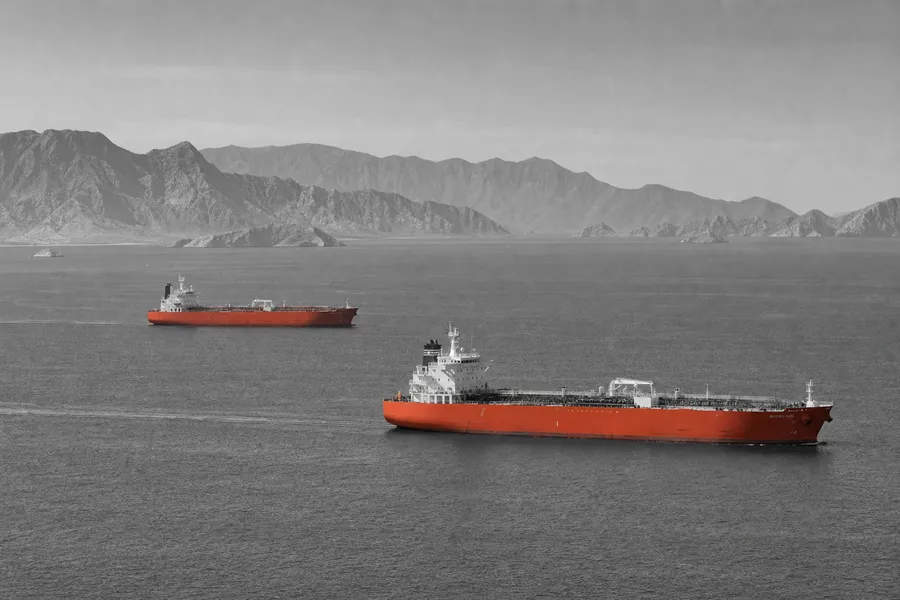
Daily tanker transits through the Strait of Hormuz fell sharply on Friday after U.S. and Iranian forces exchanged strikes this week, pushing crude oil prices toward a 5% weekly gain and reigniting supply-chain risk for energy-sector investors.
The corridor handles roughly one-fifth of global seaborne oil, making any sustained disruption a direct threat to refining margins, shipping-company earnings, and commodity-linked equity portfolios worldwide.
Key Takeaways
- Hormuz daily transits fell well below the recent 40-vessel average.
- Oil prices on track for a 5% weekly gain on supply fears.
- Qatar mediating emergency talks; U.S. ceasefire formally declared over.
Market Reaction & Context
Oil prices eased on Friday but remained on course for a weekly rise of approximately 5%, according to Reuters data, as traders priced in the risk that the waterway could tighten further 1. Prior to this week’s flare-up, daily transits had climbed to their highest level since the conflict began in late February 2026, averaging roughly 40 vessels – still only about 30% of the pre-war norm of 125 to 140 sailings per day.
The divergence between those benchmarks illustrates just how fragile the recovery in Hormuz traffic has been. Investors tracking tanker operators, LNG shippers, and downstream refiners should note that even a partial closure can materially reprice freight rates and war-risk insurance premiums; for background on how underwriters are recalibrating exposure, see this Hormuz war-risk insurance review.
Sequence of Events
Three Qatari and Saudi commercial tankers came under fire earlier in the week, prompting U.S. strikes on Iranian military sites. Iran responded Thursday with attacks on U.S. installations in neighbouring Gulf states, before both sides stood down from kinetic action on Friday 1.
The exchange shattered a June ceasefire that had ended a four-month conflict the United Nations estimated killed thousands and throttled global energy supplies. Under the interim deal, Washington had lifted its naval blockade of Iranian ports while Tehran pledged safe commercial passage – a commitment Washington now says Iran violated. The impact on Iranian crude flows adds another variable for traders already tracking shifting crude supply balances tied to Iranian export policy.
Diplomatic Track
Qatari negotiators flew to Tehran on Friday in an effort to de-escalate tensions and address disputed navigation rights, a source with direct knowledge of the talks told Reuters 1. The discussions centre on implementation of the existing U.S.-Iran memorandum of understanding and the specific triggers behind this week’s renewed hostilities.
Iran’s semi-official Tasnim news agency confirmed a Qatari delegation had arrived, framing the visit as Doha’s bid to cement its role as primary mediator between Washington and Tehran 2. The U.N. shipping agency’s governing council separately condemned Iranian efforts to impose unilateral control over Hormuz and Tehran’s creation of a body to regulate passage through the strait 1.
Outlook & Key Quote
President Donald Trump declared the June ceasefire formally terminated via Truth Social on Friday, even as he confirmed diplomacy would continue.
“The Islamic Republic of Iran has asked us to continue ‘talks.’ We have agreed to do so, but the United States has stated to them, in no uncertain terms, that the Cease Fire is OVER!” – President Donald Trump, Truth Social, July 10, 2026 1
Analysts note Iran has historically used targeted tanker incidents to gain leverage ahead of negotiations, suggesting the attacks may be tactical rather than a sign of full-scale renewed hostilities. Mojtaba Khamenei, who succeeded his father Ali Khamenei as Supreme Leader after the elder was killed on the first day of the war, has not appeared publicly since being wounded in the same strike, leaving Iran’s ultimate strategic direction uncertain 1.
Conclusion
For macro and sector investors, the core risk is a sustained interruption to a waterway that – even at its diminished war-time throughput of 40 vessels daily – remains an irreplaceable artery for Gulf crude and LNG exports. Until Qatari mediation produces verifiable commitments on safe passage, shipping equities, energy futures, and war-risk premiums are all likely to trade with an elevated geopolitical premium.
Not investment advice. For informational purposes only.
References
1Elimam, Ahmed; Abouhassira, Eman; Mills, Andrew (July 10, 2026). “Trump says US agreed to Iran’s request to continue talks, but ceasefire is over”. Reuters. Retrieved July 10, 2026.
2(July 10, 2026). “Trump Says US Agreed to Iran’s Request to Continue Talks, but Ceasefire Is Over”. U.S. News & World Report. Retrieved July 10, 2026.
3(July 10, 2026). “Tanker traffic slows in Strait of Hormuz after US and Iran clashes”. Reuters via Facebook. Retrieved July 10, 2026.
4(July 10, 2026). “Tanker traffic slows in Strait of Hormuz after US and Iran clashes”. Reuters via X (formerly Twitter). Retrieved July 10, 2026.