
War underwriters have begun advising shipping clients to pause Strait of Hormuz transits and are reviewing policy terms, a development that threatens supply-chain costs and freight-rate benchmarks across the tanker and dry-bulk sectors.
For investors tracking energy logistics, shipping equities, and commodity importers, the insurance pullback signals a potential step-change in voyage costs for roughly one-fifth of global seaborne oil trade that flows through the strait each day.
Key Takeaways
- Some war insurers advise voyage pauses; others reviewing Hormuz policy terms.
- Iran and the U.S. issue incompatible routing orders to shipowners.
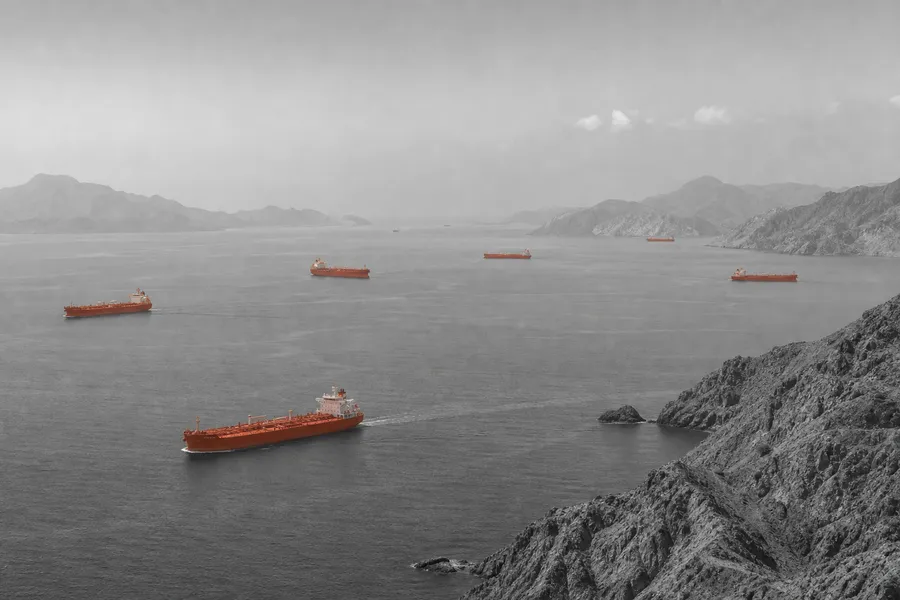
- At least four tankers damaged, two seafarers killed, 150 ships stranded.
Market Reaction & Context
The insurance market disruption lands on top of an already stressed freight environment. Reuters reported in early March 2026 that insurers had cancelled war-risk coverage for vessels in the Gulf after the widening Iran conflict left at least four tankers damaged, two seafarers killed and approximately 150 ships stranded around the strait – a scale of disruption that dwarfs the 2019-2020 tanker-attack episodes that briefly spiked war-risk premiums above 0.5% of hull value.1
The Strait of Hormuz handles an estimated 20-21 million barrels of crude and products per day, making any sustained insurance-driven traffic reduction a direct input cost for refiners, petrochemical producers and, ultimately, consumer-goods companies with energy-intensive supply chains. Investors in tanker operators such as those trading on NYSE and Oslo-listed exchanges are watching war-risk premium trajectories as a leading indicator of earnings pressure across the fleet.2
For broader context on how U.S.-Iran diplomatic signals are feeding into oil and shipping equity volatility, see Hormuz Talks Threaten Oil & Shipping Stocks Stability.
Detailed Analysis: A Two-Front Routing Crisis
The core problem for shipowners is not simply elevated premiums – it is mutually exclusive guidance from the two most powerful actors in the waterway. Iran has warned that vessels could face penalties or be turned back unless they seek advance permission from Tehran and navigate close to the Iranian coastline, according to three shipping executives cited by the Financial Times.2
The United States and a portion of western insurers, however, are directing ships to a corridor on the Omani side of the strait that falls under U.S. air cover – a route that directly contradicts Tehran’s demand. The result is what one industry observer described as “two incompatible risk signals,” leaving operators unable to satisfy both sets of instructions simultaneously.
Within the insurance market, the response has not been uniform. Some war underwriters have moved to the most conservative position – recommending voyage pauses outright – while others are taking a more deliberate approach, reviewing whether existing policy language adequately captures current threat scenarios before issuing revised guidance, insurance industry sources said on Wednesday.1
Industry trackers estimate that roughly 200 to 300 of the vessels currently stranded in the Persian Gulf are critically low or completely out of fuel, a secondary logistical crisis that compounds the routing dilemma and raises the prospect of salvage and total-loss claims that would further stress the war-risk pool.2
Investor Implications
Elevated war-risk premiums feed directly into voyage costs, which tanker operators typically pass through to charterers via higher spot rates or surcharges – a dynamic that can simultaneously boost near-term revenue for shipowners while squeezing margins for commodity traders and oil majors that charter vessels on the spot market.
If insurers move en masse to suspend coverage rather than merely reprice it, the effect is more severe: vessels without valid war-risk policies cannot legally complete voyages under most financing and charter-party agreements, effectively removing tonnage from supply and tightening the market sharply.
Outlook
“Shipowners are facing confusion over the safest route out of the Persian Gulf as Iran, the United States and western insurers issue conflicting guidance on travel through the Strait of Hormuz,” Iran International reported, citing the Financial Times.2
Until diplomatic channels produce a single, enforceable routing protocol – or one side of the standoff backs down – the insurance market is unlikely to stabilise. Analysts warn that a prolonged impasse could push effective war-risk surcharges to levels last seen during the Iran-Iraq tanker war of the 1980s, when premiums briefly exceeded 1% of cargo value per voyage.
Conclusion
The Hormuz insurance crisis has moved beyond a pricing event into a structural question about whether vessels can operate in the waterway at all without breaching either U.S. or Iranian requirements. For investors in energy, shipping, and downstream industrials, the near-term risk is a sustained reduction in effective throughput that tightens global crude and products supply – a factor likely to keep oil-price volatility elevated until a clear routing framework emerges.
Not investment advice. For informational purposes only.
References
1(March 2, 2026). “Iran conflict hits global shipping with tankers left stranded”. Reuters via Facebook. Retrieved July 8, 2026.
2(June 23, 2026). “Ships conflicting Iran, US instructions in Strait of Hormuz”. Iran International – English via Facebook, citing the Financial Times. Retrieved July 8, 2026.
3(June 22, 2026). “US and Iran give shipowners conflicting Hormuz orders”. Financial Times. Retrieved July 8, 2026.