
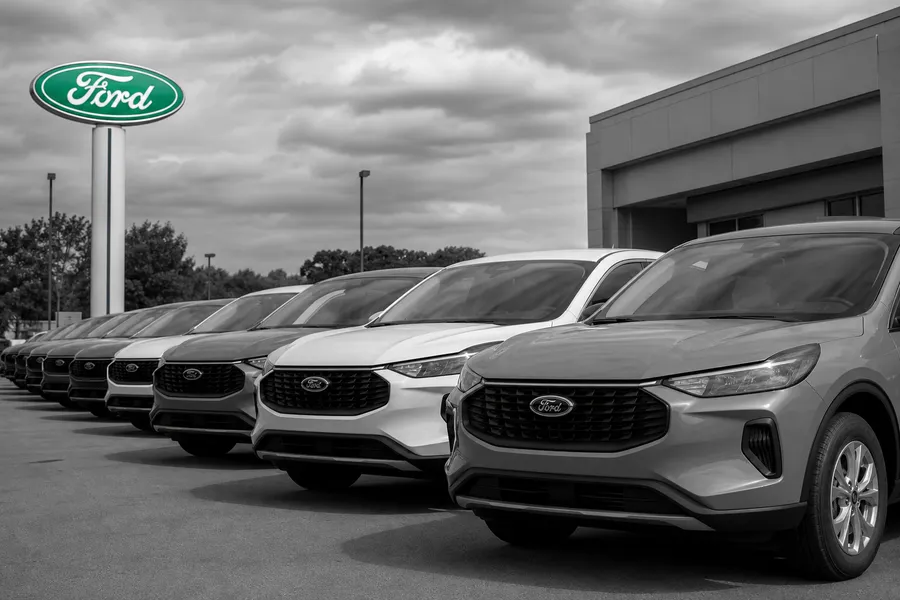
Ford Motor (F) posted a 10.3% drop in second-quarter U.S. new vehicle sales to 549,200 units, with shares sliding roughly 2% as twin drags – an aluminum supply disruption and cratering EV demand – outpaced analyst expectations for a decline of 11.5%.
The results raise fresh questions about Ford’s near-term revenue mix at a time when the expiration of the federal EV tax credit continues to reshape competitive positioning across Detroit and beyond.
Key Takeaways
- Q2 sales fell to 549,200 units, down 10.3% year-over-year
- Pure EV sales collapsed 40.7%; F-Series trucks slid 11%
- Bronco set a quarterly record; second-half supply recovery expected
Market Reaction & Competitive Context
Ford’s volume decline was among the steepest of any major automaker this quarter, though the result narrowly beat Cox Automotive’s forecast of an 11.5% drop 1. Cross-town rival General Motors (GM) reported a comparatively modest 4.2% Q2 decline, retaining its position as the top-selling U.S. automaker on the strength of trucks and SUVs, while Ford’s retail market share edged up 0.2 percentage points to an estimated 12.3% 2.
The broader industry backdrop was more constructive: automotive data firm Motor Intelligence estimated June’s seasonally adjusted annual rate at 16.67 million units, topping forecasts and marking the first time the pace cleared 17 million since July 2025 1. Hybrid vehicles were the primary engine of that strength, a trend that benefited Toyota and Honda more than Ford this cycle.
Breaking Down the Declines
The F-Series, America’s best-selling truck, accounted for a significant portion of Ford’s shortfall, with 197,900 units sold in Q2 – an 11% year-over-year decrease – and 357,801 units through the first half, down 13.3% 2. Ford attributed the weakness not to softening consumer demand but to a production retiming following fires at its top aluminum supplier late last year, which disrupted commercial-fleet build schedules.
The EV segment delivered the harshest numbers. Ford’s pure-EV sales fell 40.7% to 9,746 units in Q2, with the Mustang Mach-E off 30.9% and the now-discontinued F-150 Lightning down 58.6% 2. Through the first half, total EV sales are down 57.4% – a trend shared by GM, whose own electric models also tumbled after the federal EV tax credit expired at the end of Q3 2025. Hybrids declined 20% for Ford even as rivals captured gains in that segment.
Bright Spots: Bronco, Explorer and Affordable EVs Ahead
Not every nameplate declined. The Bronco rose 15.9% to a quarterly record of 45,739 units, outselling the Jeep Wrangler for the period, while the Explorer gained 13.8% to 65,538 2. Combined Bronco, Explorer, and Expedition first-half sales rose 10.1%, which Ford said was the best showing for that high-margin group in 25 years.
The Maverick Hybrid also set a Q2 record at 29,457 units, up 19.3%, and the Mustang bucked a broadly shrinking car market with a 22% first-half increase to 28,725 2. Ford noted it outsold the Chevrolet Silverado by more than 80,000 trucks through June, preserving the F-Series’ leadership position despite the supply-driven volume loss.
Outlook & Management View
Ford said it expects the aluminum supply constraint to ease materially in the second half, with commercial F-Series production ramping back toward normalized levels 1. Retooling is also underway at the Louisville Assembly Plant for an affordable small four-door electric pickup on Ford’s Universal EV platform, due next year.
“We’re going to be launching five or six new affordable vehicles, and the first one is transformational. It’ll be our less-than-$30,000 new electric truck coming out next year.” – Ford CEO Jim Farley 2
Andrew Frick, president of Ford Blue and Model e, said gaining retail share “even as we are phasing out some high-volume models shows the strength of the Ford lineup.” 2 Ford also noted that, excluding the Escape and Lincoln Corsair phase-outs and a 69% cut in daily rental sales, adjusted Q2 volume would have risen an estimated 0.5%.
Sector Positioning
Ford’s EV struggles come as the broader industry recalibrates after the federal credit expiry – a dynamic also pressuring GM’s competitive positioning against Toyota in key volume segments. Meanwhile, European automakers are doubling down on U.S. EV infrastructure to capture share from a weakening Detroit lineup, with commitments like BMW’s $1.7 billion South Carolina EV investment signaling long-term competitive intent.
For Ford investors, the second half narrative hinges on two parallel recovery curves: the aluminum supply chain normalizing for F-Series commercial sales, and the sub-$30,000 EV launch rekindling Model e momentum. Year-to-date sales stand at just over one million units, down 9.6% from the same period in 2025 1.
Not investment advice. For informational purposes only.
References
1Wayland, Michael (2026-07-02). “Ford Q2 sales drop 10.3% due to F-Series supplier issue, falling EV demand”. CNBC. Retrieved 2026-07-02.
2Subramanian, Pras (2026-07-02). “Ford Q2 sales slide 10% on EV drop and model phase-outs; Bronco and Maverick hybrid set records”. Yahoo Finance. Retrieved 2026-07-02.