
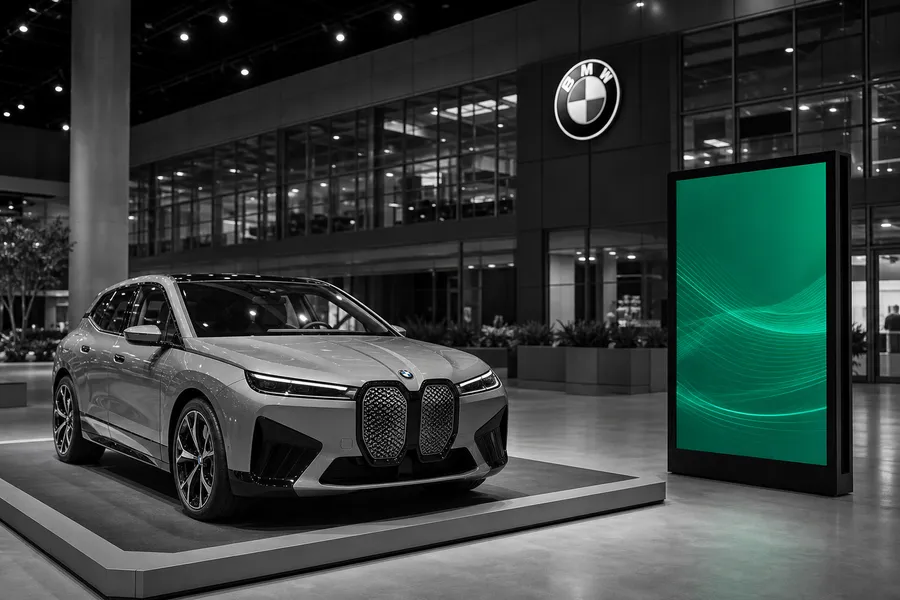
BMW AG confirmed plans to build at least six electric SUVs at its Spartanburg, South Carolina plant by 2030, backed by a $1.7 billion investment that positions the German automaker as one of the most aggressive legacy players in U.S. electric-vehicle manufacturing.
For investors watching the widening divergence in EV commitment across global automakers, BMW’s supply-chain verticalization – pairing a new battery plant with a dedicated cell supplier on U.S. soil – signals a structurally different cost and tariff exposure than rivals who have slowed or paused electrification spending.
Key Takeaways
- BMW’s iX5 electric SUV enters Spartanburg production in 2026.
- $700 million battery plant in Woodruff, S.C., creates 300-plus jobs.
- Six fully electric X-model SUVs targeted for U.S. output by 2030.
Competitive Context & Market Positioning
While Ford Motor (F) and General Motors (GM) have collectively written down billions in EV losses and trimmed near-term production targets, BMW is accelerating capital deployment into American soil – a strategic asymmetry that analysts say could yield tariff insulation and IRA-adjacent cost advantages.1 The Spartanburg plant already holds the title of largest BMW Group production site globally, shipping more than 1,500 vehicles daily to roughly 120 markets and generating over $10 billion in export value in 2024 alone.3
That export footprint makes Spartanburg a natural anchor for BMW’s EV pivot. Every second vehicle built there is currently exported, meaning electrified variants of the X5, X6, and X7 would be positioned for both domestic U.S. sales and international distribution from the same facility.3
The Supply Chain Architecture
BMW’s approach relies on a tightly linked in-state supply corridor. Battery cells will be produced by partner AESC at a new 30 GWh factory in Florence, South Carolina, then shipped to BMW’s “Plant Woodruff” in nearby Woodruff for assembly into sixth-generation high-voltage packs, before final vehicle integration at Spartanburg.1
The new cylindrical lithium-ion cell format promises more than 20% greater energy density and up to 30% improvements in both charging speed and range versus current-generation batteries, according to BMW.1 CO₂ emissions from cell production are targeted to fall by up to 60% through partial use of secondary lithium, cobalt, and nickel alongside renewable energy.1
Model Roadmap & Revenue Implications
The electric iX5 is slated to roll off the Spartanburg line in mid-2026, followed by the iX7 – BMW’s first full-size zero-emissions luxury SUV – in 2027.2 An electric iX6 coupe and a high-performance iX5 M70 are targeted for 2028, with a flagship iX7 M70 reportedly planned with more than 800 horsepower.2, 3
The iX5 is expected to compete directly with the Tesla Model X and Cadillac Vistiq in the mid-size premium segment, while the iX7 targets rivals such as the Cadillac Escalade IQ – a market tier that commands retail prices well above $100,000 and carries outsized per-unit margins.2
Management Outlook
“Every second vehicle built at our Spartanburg plant is exported, generating an export value of over $10 billion in 2024 alone. Over the past 10 years, our total export value has exceeded $100 billion. Now, we are investing over $1.7 billion to bring Spartanburg up to speed for e-mobility. The first e-model from Spartanburg will already roll off the assembly line next year.”
– Oliver Zipse, Chairman of the Board of Management, BMW AG, at the company’s 105th Annual General Meeting, May 2025.3
Plant Woodruff will operate without fossil fuels on 100% green electricity, and the facility’s design incorporates CarbonCure concrete technology that permanently sequesters CO₂ at a molecular level – features BMW said support its commitment to cut lifecycle CO₂ emissions per vehicle by 40% by 2030.1
Workforce & Long-Term Investment Scale
More than 300 jobs will be created at Plant Woodruff at opening, with capacity to grow, while BMW’s existing 11,000-strong Spartanburg workforce will be retrained through a new Technical Training Center that opened in October as the central EV upskilling hub for North and South America.1 Since 1992, BMW has invested nearly $12.4 billion in its South Carolina operations, a figure the current cycle is set to extend materially.1
The local-for-local supply structure – U.S. cell production, U.S. battery assembly, U.S. vehicle output – also provides BMW with a degree of insulation from the volatile landscape of import tariffs that has disrupted competitors relying on cross-border battery and component flows.2
Conclusion
BMW’s South Carolina expansion represents one of the most vertically integrated EV manufacturing bets by any legacy automaker on American soil. Whether the capital deployed ahead of the cycle translates into durable margin expansion will depend on consumer adoption of premium electric SUVs – but the infrastructure foundation is now clearly in place.
Not investment advice. For informational purposes only.
References
1BMW Group PressClub. “BMW Group Breaks Ground on New High-Voltage Battery Assembly Factory in South Carolina.” BMW Group PressClub USA. Retrieved June 30, 2026.
2(June 9, 2025). “Electric BMW X5, X6, and X7 SUVs to Be Produced at the Automaker’s U.S. Plant.” EV.com. Retrieved June 30, 2026.
3(June 9, 2025). “BMW to Build Three EVs at Spartanburg Plant Beginning in 2026.” Repairer Driven News. Retrieved June 30, 2026.
4The Globe and Mail (October 20, 2022). “BMW to invest $1.7-billion to build electric vehicles in U.S.” The Globe and Mail via Facebook. Retrieved June 30, 2026.
5The Electric Viking (November 1, 2022). “BMW’s $1.7B EV Investment in South Carolina + Giga Kentucky.” YouTube. Retrieved June 30, 2026.