
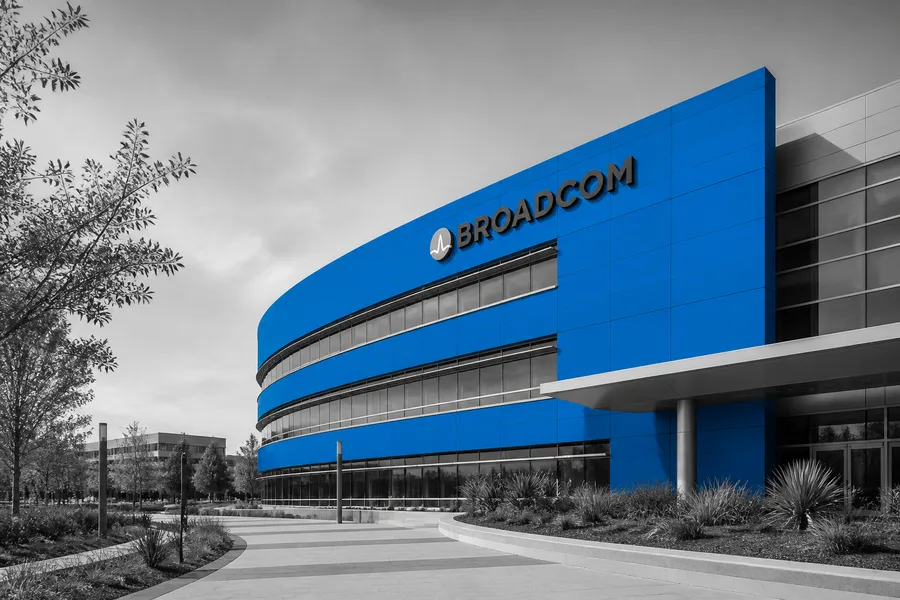
A coalition of major banks and Blackstone have assembled a $63 billion financing vehicle to buy AI computing infrastructure from Broadcom (AVGO) and lease it to Anthropic, marking one of the largest structured-finance deals ever tied to artificial intelligence.
The transaction signals that institutional capital is now moving beyond equity speculation in AI and into asset-backed infrastructure financing – a shift that could reshape how chipmakers and hyperscalers fund the next generation of computing buildout.1
Key Takeaways
- $63 billion financing vehicle targets Broadcom AI compute infrastructure.
- Blackstone leads alongside major banks; Anthropic is end lessee.
- Deal represents a landmark shift toward asset-backed AI capital.
Market Context & Scale
At $63 billion, the facility dwarfs most single-asset infrastructure financings on record and is roughly equivalent to Broadcom’s entire annual revenue run-rate as of its most recent fiscal year. For context, the broader AI infrastructure investment market – spanning data centers, networking, and custom silicon – is estimated to exceed $200 billion annually, making this deal a structurally significant slice of that capital pool.1
Broadcom has positioned itself as the dominant custom-chip designer for hyperscale AI workloads, with its XPU business drawing commitments from Google, Meta, and now Anthropic’s infrastructure backers. The stock has outpaced the Philadelphia Semiconductor Index (SOX) by a wide margin over the past 12 months, underpinned by accelerating custom-silicon revenue.
Detailed Analysis
The structure of the deal is notable: rather than Anthropic purchasing compute capacity outright, a special-purpose vehicle backed by bank debt and Blackstone equity will acquire the hardware from Broadcom and lease it back to the AI startup. This arrangement allows Anthropic to access large-scale compute without burdening its balance sheet, while giving lenders a hard-asset claim on the underlying silicon.1
For Broadcom, the arrangement effectively pre-sells a substantial pipeline of custom AI accelerators, reducing revenue uncertainty and providing visibility that chipmakers rarely enjoy in a cyclical industry. The model mirrors infrastructure-financing structures long used in aircraft leasing and data-center real estate investment trusts, now applied to semiconductor hardware at unprecedented scale.
Blackstone’s involvement as the equity anchor is equally telling. The alternative-asset manager has been aggressively building an AI infrastructure portfolio, and its participation here lends credibility to the collateral valuation – a critical concern for bank lenders assessing how quickly bespoke AI chips might depreciate or become obsolete. The speed at which AI hardware generations turn over remains a key risk variable for any lender in this structure.
Outlook & Competitive Positioning
The deal intensifies competitive pressure on Nvidia (NVDA), which has dominated AI accelerator revenue but faces an emerging threat from the custom-chip market that Broadcom serves. If asset-backed financing vehicles become a repeatable mechanism for funding custom-silicon procurement, it could accelerate customer migration away from off-the-shelf GPUs toward application-specific designs – a structural tailwind for Broadcom’s ASIC business.
“A coalition of major financial institutions is lining up $63 billion in financing to purchase artificial-intelligence computing infrastructure from Broadcom and lease it to Anthropic,” the Wall Street Journal reported, citing people familiar with the matter.1
Anthropic, which competes directly with OpenAI in the large-language-model market, gains a substantial and stable compute base without diluting equity or drawing down existing credit lines – a competitive advantage in a sector where compute access is increasingly the binding constraint on model development velocity.
Conclusion
The $63 billion vehicle represents more than a single transaction; it is a template for how the AI industry may finance its infrastructure ambitions as capital requirements outpace what any single corporate balance sheet can absorb. For investors tracking Broadcom, the deal provides a rare demand-visibility signal in a business notorious for forecast opacity. For the broader market, it underscores that AI’s capital intensity is now attracting the same structured-finance machinery that built modern telecom networks and commercial aviation – with all the leverage and duration risk that implies.
Not investment advice. For informational purposes only.
References
1(2026, October 26). “Banks, Blackstone Form $63 Billion Financing Vehicle for Broadcom AI Tech”. The Wall Street Journal. Retrieved October 26, 2026.