
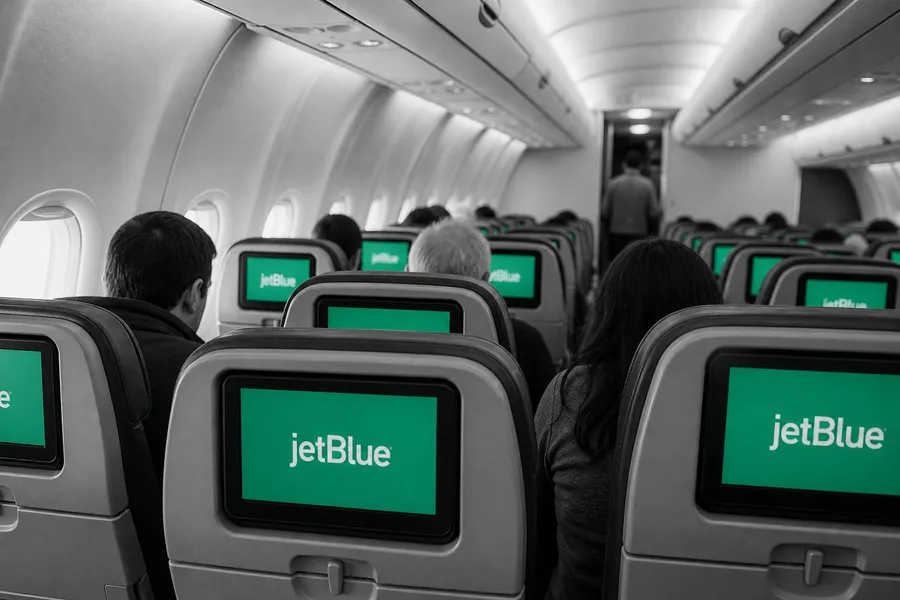
JetBlue Airways (JBLU) shares fell sharply Monday as surging jet-fuel costs raised fresh doubts about the carrier’s multi-year turnaround plan and its ability to return to sustainable profitability.
For retail investors tracking the airline sector, the development signals that external cost pressures may erode the operating leverage JetBlue has been counting on to close the gap with larger, better-hedged network rivals.
Key Takeaways
- Elevated fuel prices are threatening JetBlue’s path back to profit.
- JBLU underperforms peers as cost pressures intensify in late 2026.
- Management insists turnaround strategy remains on track.
Market Reaction & Context
JBLU’s decline on Monday stood out against a mixed session for U.S. airline stocks, with legacy carriers such as Delta Air Lines (DAL) and United Airlines (UAL) showing relative resilience, in part because of more sophisticated fuel-hedging programs that partially insulate them from spot-price swings 1. JetBlue, which operates with a leaner balance sheet and fewer hedging instruments following its failed bid to acquire Spirit Airlines, has less financial cushion to absorb the kind of fuel-cost spikes that have re-emerged in the fourth quarter of 2026.
Jet-fuel prices have climbed materially in recent months, tracking a broader uptick in crude benchmarks. For an airline where fuel routinely represents 20% to 30% of total operating costs, even a modest per-gallon increase can translate into hundreds of millions of dollars in annualised headwinds.
Detailed Analysis
JetBlue entered 2026 in the middle of a structural overhaul – dubbed its “JetForward” initiative – aimed at cutting costs, optimising its route network, and rebuilding margins that collapsed after pandemic-era expansion outpaced revenue recovery. The strategy has shown incremental progress, including capacity discipline and ancillary-revenue growth, yet the airline has not yet returned to consistent operating profitability.
Fuel costs are the most significant wildcard in that equation. Unlike labour, which can be managed through multi-year contracts, or maintenance, which can be deferred within limits, fuel exposure is largely a function of market prices and hedging strategy. JetBlue’s hedging book is considerably smaller than those of the major network carriers, leaving it more exposed when energy markets tighten 1.
The pressure comes at a particularly sensitive moment. Investors had been watching for signs that cost reductions were outpacing revenue softness in JetBlue’s core leisure-travel markets, particularly in the Northeast United States and the Caribbean. A sustained rise in fuel costs could force management to revisit capacity plans or raise ticket prices into a consumer environment that remains sensitive to airfare inflation.
Outlook & Management Comment
Despite the headwinds, company executives pushed back against pessimism about the airline’s trajectory. Executives said the airline “remains confident in its strategy and sees progress in returning to profitability,” signalling that the board does not view the current fuel environment as a reason to abandon the turnaround framework 1.
“The airline remains confident in its strategy and sees progress in returning to profitability.”
– JetBlue Airways executives, October 2026
Whether that confidence is validated will depend heavily on how fuel prices evolve through the winter travel season and whether JetBlue can offset cost headwinds with stronger unit revenue – a metric the market will scrutinise closely in upcoming quarterly results.
Conclusion
JetBlue’s situation illustrates a structural vulnerability that smaller, less-diversified carriers face when commodity costs spike: the margin for error is thin, and the timeline for recovery can stretch significantly. Until JBLU demonstrates it can generate consistent operating profit in a higher-fuel-cost environment, the stock is likely to remain under pressure relative to its network-carrier peers. Investors should watch fuel-price trends, fourth-quarter capacity updates, and any guidance revisions as the next meaningful catalysts for the shares.
Not investment advice. For informational purposes only.
References
1(2026, October 26). “JetBlue Shares in Tailspin as High Fuel Prices Threaten Turnaround”. The Wall Street Journal. Retrieved October 26, 2026.