
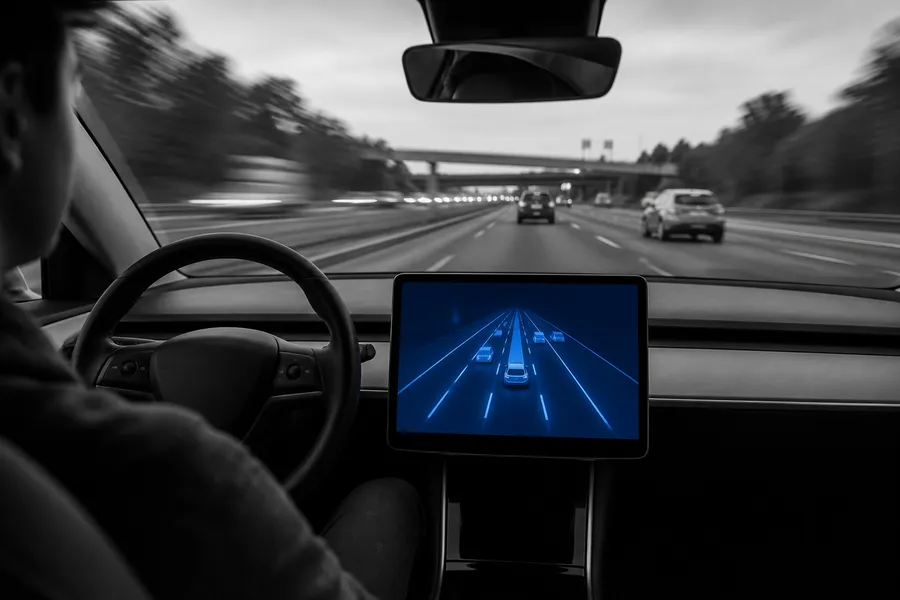
A US appeals court on Friday blocked California Tesla (TSLA.O) customers from pursuing class action suits over full self-driving claims, removing a significant litigation overhang for the EV maker.
The ruling narrows the legal battlefield for Tesla at a moment when its autonomous-driving roadmap is central to the bull case, making the outcome directly relevant to how investors price FSD’s long-term revenue potential.
Key Takeaways
- Appeals court vacates order that certified California FSD class action.
- Ruling reduces near-term liability risk tied to FSD marketing claims.
- Outcome could reshape how Tesla discloses autonomous-driving capabilities.
Market Reaction & Context
The decision lands as Tesla shares have faced persistent pressure alongside broader EV-sector peers, with competitors including Rivian and Lucid also navigating regulatory and consumer-trust headwinds around advanced driver-assistance systems.1 Removing a class-action threat of this scale-one that could have exposed Tesla to damages across thousands of California buyers-qualifies as a material litigation risk reduction for TSLA holders.
Class actions in the automotive technology space have historically resulted in settlements running into the hundreds of millions of dollars, making Friday’s ruling a meaningful data point for investors modeling Tesla’s contingent liabilities.
What the Court Decided
The US appeals court threw out a lower-court order that had allowed Tesla customers in California to band together to pursue claims that the company misled them about the capabilities of its Full Self-Driving technology.1 By decertifying the class, the appeals panel effectively forces any aggrieved customers to pursue claims individually-a far costlier and less commercially viable path that typically deters mass litigation.
The core allegation was that Tesla’s marketing overstated what FSD could actually do, a charge that has dogged the company as regulators in multiple jurisdictions examine the gap between product branding and real-world performance. Notably, Tesla has previously adjusted how it labels and describes FSD in response to regulatory feedback; the company shifted the FSD name amid EU regulator pressures, signalling sensitivity around the terminology.
Detailed Analysis
The decertification ruling is procedurally significant: class certification is often described by litigators as the pivotal moment in consumer fraud cases, because defendants face asymmetric settlement pressure once a class is certified. Reversing that certification at the appellate level hands Tesla’s legal team a structural advantage heading into any future proceedings.
For retail investors, the cleaner litigation profile matters beyond the immediate quarter. Analysts tracking Tesla’s FSD monetisation thesis-subscription revenue, robotaxi licensing, and potential third-party licensing-have consistently flagged unresolved consumer-fraud exposure as a discount factor on those revenue streams.
The ruling does not resolve underlying regulatory scrutiny from the National Highway Traffic Safety Administration or state-level bodies, which operate independently of civil class action mechanics. Those probes remain active and represent a separate, parallel risk vector for TSLA shareholders.
Outlook
Tesla has not issued a public comment on the appeals court decision as of publication time. The company has previously defended FSD’s marketing by arguing that its disclosures made clear the technology requires driver supervision, a position the appeals court’s ruling does not explicitly endorse or reject on the merits.
“Class certification is often the ballgame in consumer fraud litigation-without it, the economics of pursuing individual claims rarely pencil out,” one securities litigation analyst said, reflecting a widely-held view among plaintiffs’ bar observers.
Whether plaintiffs attempt to appeal further or refile with a narrower class definition remains to be seen. Legal experts note that appellate decertifications of this type are rarely reversed, suggesting the class action route for this particular set of FSD claims is largely foreclosed.1
Conclusion
Friday’s appellate ruling removes one of the more structurally threatening legal challenges to Tesla’s autonomous-driving business, reducing the probability of a large class-wide damages award tied to FSD marketing. The outcome does not eliminate regulatory or individual litigation risk, but it materially improves Tesla’s legal posture at a time when the FSD narrative is among the most consequential drivers of the stock’s long-term valuation.
Not investment advice. For informational purposes only.
References
1(October 16, 2026). “US appeals court blocks class actions over Tesla’s self-driving claims”. Reuters. Retrieved October 16, 2026.