
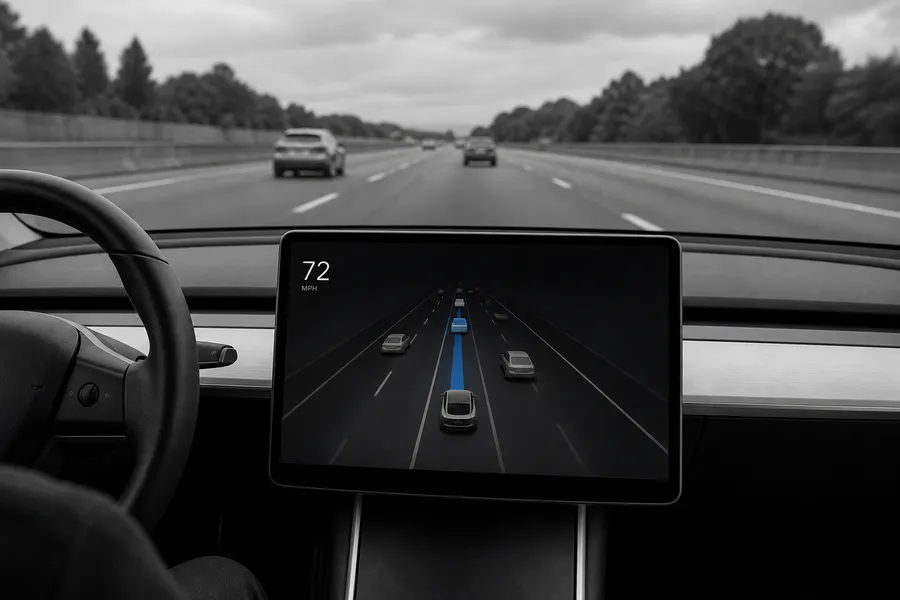
Tesla (TSLA) quietly rebranded its “Full Self-Driving (Supervised)” system as “Assisted Driving” across Europe on Friday after German regulators deemed the original label “somewhat misleading,” a concession that underscores the compliance headwinds facing the company’s highest-margin software ambitions.
For investors pricing in FSD as a recurring-revenue engine, the European retreat raises a pointed question: how much of Tesla’s reported 1.48 million active FSD subscriptions – and the $99-per-month U.S. price tag attached to them – depends on branding that regulators outside North America are no longer willing to accept.
Key Takeaways
- German regulators called “Full Self-Driving” branding “somewhat misleading.”
- Tesla reported 1.48 million active FSD subscriptions as of Q2 2026.
- NHTSA is separately probing FSD safety in reduced-visibility conditions.
Regulatory Context & Market Reaction
The name change follows a Tuesday statement from Germany’s Federal Ministry of Transport (BMV), which said the FSD label overstated the system’s capabilities, noting that “the driver must remain attentive at all times.” 1 Tesla shares were little changed in afternoon trading Friday, reflecting the market’s tentative read that the rebrand is a cosmetic rather than commercial setback – though that calculus could shift if European subscription volumes disappoint.
Peer autonomous-driving developers including Waymo and Mobileye have faced similar nomenclature scrutiny in various jurisdictions, but neither has yet launched a consumer subscription product at scale in Europe, leaving Tesla to absorb the regulatory friction largely alone. The episode also arrives as elevated oil prices tied to the Iran conflict have boosted European EV demand more broadly, a tailwind Tesla will want to capture without triggering further regulatory friction.
The Revenue Exposure
Tesla’s second-quarter earnings update disclosed 1.48 million “active” FSD subscriptions globally, but did not break out how many were activated through free trials or promotional incentives rather than paid sign-ups. 1 At $99 per month per subscription, even a modest churn in European conversions – or a failure to upsell the rebranded “Assisted Driving” package at equivalent prices – could dent the software segment that bulls consider Tesla’s most defensible margin story.
The Dutch safety regulator RDW approved Tesla’s system for European release, but the approval process has drawn criticism for its opacity. Autonomous systems expert Missy Cummings, an engineering professor at George Mason University, said European agencies are
“ignoring both past and ongoing NHTSA investigations”
into safety defects with Tesla’s FSD, adding that the RDW approval was “based on secretive data.” 1
Regulatory Overhang Widens
The European rebrand is not an isolated event. Reuters reported this week that Tesla had in some cases pressured EU regulators to reduce the intensity of their safety reviews – conduct described as “browbeating” – raising the prospect of a political backlash that could slow approvals further. 1 Separately, the U.S. National Highway Traffic Safety Administration is investigating whether FSD is safe to operate in fog, glaring sun, and other reduced-visibility conditions, and whether the system has caused drivers to commit traffic violations resulting in collisions.
A California judge in December 2025 found that Tesla engaged in deceptive marketing around Autopilot and FSD, and the company is contesting that ruling in Los Angeles superior court – litigation that remains unresolved. 1 The cumulative weight of these proceedings represents a material disclosure risk that investors focused on Tesla’s software growth narrative should monitor closely.
Analyst & Expert View
Cummings was blunt in her assessment of the broader dynamic: “The EU is struggling to keep up in the AI marketplace. Musk sees this and is definitely bullying them as a result.” 1 She said that renaming FSD is insufficient to ensure safety, and called on the public to “demand transparency in any approval of a transportation system with embedded AI.”
Tesla and the Dutch regulator RDW did not respond to requests for comment by publication time. The company continues to market the system under its original Full Self-Driving branding in the United States at $99 per month.
Bottom Line
The European rebrand is, on its surface, a marketing adjustment. But it crystallises a pattern: Tesla’s FSD commercial rollout is encountering a thickening layer of regulatory, legal, and reputational friction across multiple jurisdictions simultaneously. Until the company can demonstrate clean regulatory passage in at least one major European market – on transparent terms – the autonomous-driving premium embedded in TSLA’s valuation carries execution risk that quarterly subscription numbers alone cannot fully resolve.
Not investment advice. For informational purposes only.
References
1Kolodny, Lora (2026-10-09). “Tesla drops ‘Full Self-Driving’ brand name in Europe after regulator pushback”. CNBC. Retrieved 2026-10-09.