
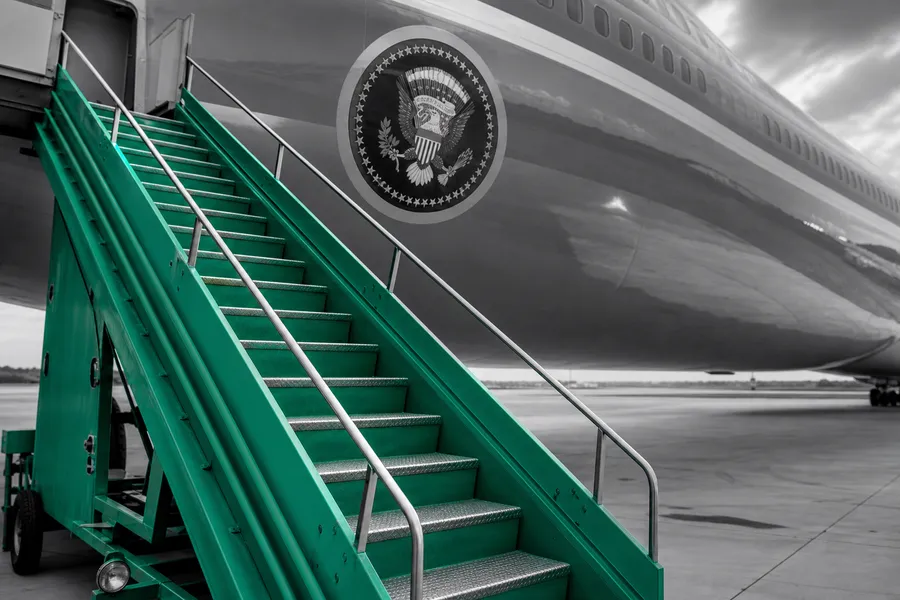
The U.S. Justice Department subpoenaed four New York Times journalists on Friday over reporting on security vulnerabilities in the Qatar-gifted presidential aircraft, escalating a government crackdown on press sources that advocacy groups called an unprecedented constitutional threat.
For macro investors, the move signals a widening regulatory and political risk premium attached to major media companies – including New York Times Co. (NYT) – as the administration intensifies its use of the federal grand jury process to probe classified leaks through journalists rather than officials alone.
Key Takeaways
- DOJ subpoenaed four NYT reporters over Qatari Air Force One security story.
- Grand jury appearance set for Wednesday; subpoenas delivered to reporters’ homes.
- Press-freedom groups warn of direct First Amendment threat to independent media.
The Trigger: Air Force One Security Reporting
The Times published stories raising security concerns about the Boeing 747-8 wide-body jet donated by Qatar’s government, which entered presidential service on or around July 1, 2026.1 Trump briefly opted to fly a legacy aircraft on the return leg from the NATO summit in Ankara before eventually boarding the new Qatari plane at RAF Mildenhall in Britain for the transatlantic flight home.2
The subpoenas, signed by Jay Clayton – the Manhattan U.S. attorney recently nominated by Trump to lead the Office of the Director of National Intelligence – demand the reporters appear before a federal grand jury in Manhattan this Wednesday.1 In some cases, federal agents hand-delivered the legal orders to journalists’ private residences, according to the Times.
Market Context & Regulatory Risk
New York Times Co. shares trade under ticker NYT on the New York Stock Exchange. While no immediate intraday move was attributed directly to the subpoena news – markets were closed for the weekend when the story broke – analysts tracking media-sector regulatory risk note that government legal pressure on newsrooms can raise operating costs through litigation and chill advertising relationships.
The episode arrives as broader macro risk appetite is already compressed by simultaneous geopolitical flashpoints, including U.S. airstrikes on Iranian targets following the closure of the Strait of Hormuz – a development with its own commodity and supply-chain consequences for investors monitoring energy corridors. For readers tracking geopolitical spillovers into commodities, the Iran oil market disruption and its crude price implications remain a parallel pressure point.
DOJ Position vs. Press-Freedom Response
A Justice Department spokesperson, responding to Reuters, neither confirmed nor denied the subpoenas but said the administration’s focus was on government officials who allegedly leaked classified information – not on the reporters themselves.1 The White House directed all further questions to the Justice Department.
That framing was rejected by major journalism advocacy organisations. The National Press Club called on the DOJ to “immediately” withdraw the subpoenas, saying that federal agents arriving at journalists’ homes with legal orders was “an extraordinary assault on the freedom of the press that strikes at the heart of the First Amendment.”1
Clayton Confirmation Hearing Becomes a Flashpoint
The Reporters Committee for Freedom of the Press called on the Senate Intelligence Committee to hold Clayton accountable when he appears for his ODNI confirmation hearing – scheduled, notably, for the same Wednesday that reporters have been ordered to testify before the grand jury.1
“When the public’s right to know is crushed, as the Trump Administration is trying to do with its subpoenas against The New York Times, all of us suffer irreparable harm, as does the freedom upon which this nation is built,” said Stephen J. Adler, chairman of the Reporters Committee for Freedom of the Press.1
The overlap between Clayton’s confirmation timeline and the grand jury date has drawn sharp criticism from civil liberties advocates, who argue the scheduling creates political pressure on both fronts simultaneously.
Broader Implications for Independent Media
Legal scholars note that using grand jury subpoenas to compel journalists to reveal sources – rather than pursuing the alleged leakers directly – represents a significant procedural escalation beyond the approach taken by most prior administrations.2 Should the subpoenas survive legal challenge, the precedent could deter confidential sourcing across the industry, narrowing the information environment that sophisticated investors rely on for policy and regulatory intelligence.
The Times characterised the action as “an extraordinary escalation in President Trump’s efforts to threaten and intimidate independent news organisations,” a description the DOJ has not directly disputed.1
Conclusion
The Justice Department’s subpoenas against four New York Times journalists mark the sharpest confrontation yet between the current administration and a major U.S. news organisation. With a grand jury date set for Wednesday and Clayton’s Senate hearing on the same day, the coming week will test both the legal limits of press protections and the independence of the confirmation process – risk variables that macro-focused investors tracking rule-of-law and media-sector exposures should monitor closely.
Not investment advice. For informational purposes only.
References
1Associated Press (July 11, 2026). “Trump administration subpoenas New York Times journalists over Air Force One story, newspaper says”. CNBC. Retrieved July 11, 2026.
2Alexandra Marquez, Kelly O’Donnell, Julie Tsirkin (July 11, 2026). “Trump administration subpoenas New York Times journalists over new Air Force One reporting”. NBC News. Retrieved July 11, 2026.
3(July 11, 2026). “New York Times reporters subpoenaed after Air Force One reporting, according to newspaper”. KUTV 2 News Salt Lake City via YouTube. Retrieved July 11, 2026.