
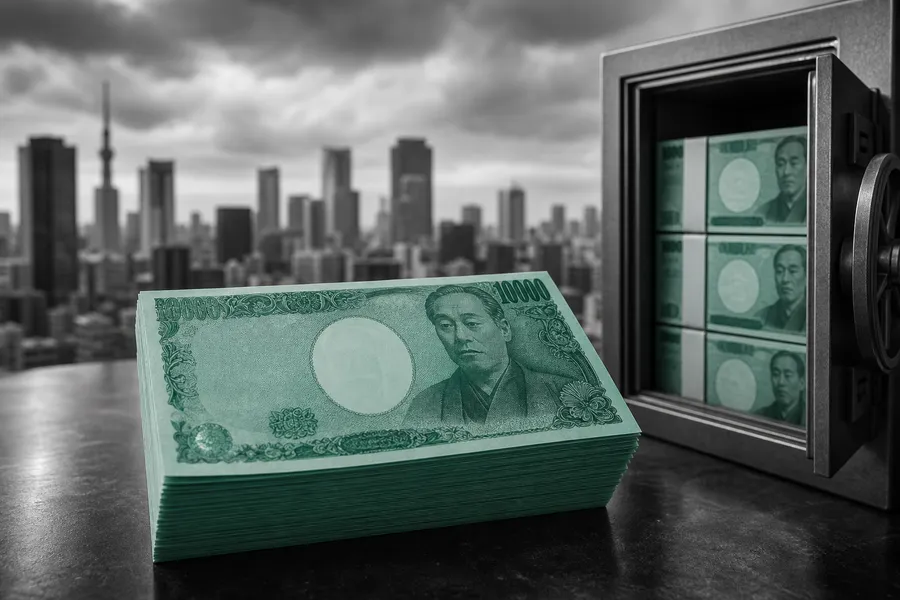
Goldman Sachs said Japan’s roughly $1 trillion in dollar reserves gives Tokyo firepower for multiple additional yen-support operations, even as USD/JPY drifts back toward the critical 160 level.
For macro traders and carry-trade investors, the analysis matters because it raises the credibility of Japan’s intervention threat-potentially capping the rate of yen depreciation that has fuelled a 45% slide over five years.
Key Takeaways
- Japan holds ~$200 billion in liquid reserves for immediate yen defence.
- Fed FIMA repo facility could unlock the full $1 trillion if needed.
- BOJ September rate decision is the pivotal near-term trigger.
War Chest & Market Context
Of Japan’s approximately $1 trillion in U.S. dollar reserves, Goldman Sachs estimates around $200 billion sits in cash or cash equivalents-roughly matching the scale of last month’s historic joint U.S.-Japan intervention, which the bank called Japan’s biggest two-day currency operation on record outside October 2011 1. By contrast, the European Central Bank’s foreign-exchange buffer is far smaller, underscoring how uniquely positioned Tokyo is among G7 central banks to sustain prolonged currency defence.
The yen had rallied past its 200-day moving average of 158 per dollar following the late-July operation, when the U.S. joined Japan in a coordinated yen-support effort for the first time since 1998. Those gains have since eroded, with USD/JPY slipping back toward 160 by mid-week-giving back roughly half the post-intervention move.
Detailed Analysis: The Capacity Argument
Goldman Research strategist Karen Fishman said the liquid portion of reserves alone is sufficient to repeat the July operation at least twice. “They already have at their disposal enough to do another couple rounds of what we just saw,” Fishman said on Goldman’s Exchanges podcast, adding: “Realistically, they wouldn’t come close to using all of that, but I think that just sort of hits home the point that they have plenty of capacity to keep intervening if they wish.” 1
Critically, Japan’s finance ministry said it plans to tap the Federal Reserve’s FIMA repo facility, which lets central banks pledge Treasury holdings for dollar liquidity without dumping securities on the secondary market 1. That mechanism would, in theory, render the full $1 trillion accessible in liquid form-a disclosure that Goldman’s Praneet Shah said caused clients to “get quite bulled up on the yen” last week.
What Would Trigger the Next Move
Shah, head of FX options trading at Goldman, said the dominant driver of USD/JPY remains the carry differential between U.S. and Japanese borrowing rates. The 10-year U.S. Treasury yield stood at 4.690% late Wednesday versus 2.839% for the equivalent Japanese government bond-a spread that continues to reward dollar-long positions 1.
Markets currently price a 65% probability of a 25-basis-point Bank of Japan hike in September and roughly 40 basis points of total tightening by year-end. “If they don’t deliver” a September hike, Fishman said, “that would put renewed downward pressure on the yen.” 1
On the U.S. side, July CPI came in line with forecasts-rising 0.1% month-on-month, with the annual rate easing to 3.4% from 3.5% in June-so the data did not independently reignite intervention bets. Shah pointed to July 2024, when a U.S. CPI miss compounded by a payrolls miss amplified the impact of a BOJ-Ministry of Finance operation into one of the most effective rounds on record.
Intervention as Time-Buyer, Not Structural Fix
Options markets signal persistent vigilance: elevated premiums on short-dated yen calls suggest traders are still hedging against a sudden gap move higher in the yen, which itself deters fresh selling pressure. “If spot is trading up into 160, there’s a real risk that you don’t want to continue selling yen when you’ve got this large risk of a drawdown still priced by the market,” Shah said 1.
Fishman was clear-eyed about the structural limits of intervention, noting that after Japan’s solo operations in April and May the yen was back at 40-year lows within months. The BOJ would need to hike at a pace faster than current market pricing to meaningfully erode the carry incentives driving yen weakness-a high bar given Japan’s still-fragile domestic demand backdrop.
Outlook
Goldman’s analysis effectively sets a two-variable watch: any upside miss on U.S. labour or inflation data that softens the Federal Reserve’s stance, combined with a BOJ hike delivery in September, would be the combination most likely to make intervention unnecessary. Conversely, a BOJ disappointment alongside sticky U.S. data could push USD/JPY back toward the 164 level that prompted coordinated action in late July-and test whether Tokyo exercises its considerable remaining firepower.
“Any misses, I think the market will really start to increase expectations of a subsequent intervention later this week.” – Praneet Shah, Head of FX Options Trading, Goldman Sachs 1
Not investment advice. For informational purposes only.
References
1(2026-08-13). “Goldman says Japan’s $1 trillion of reserves leaves ‘plenty of capacity’ for further yen interventions”. CNBC. Retrieved 2026-08-13.