
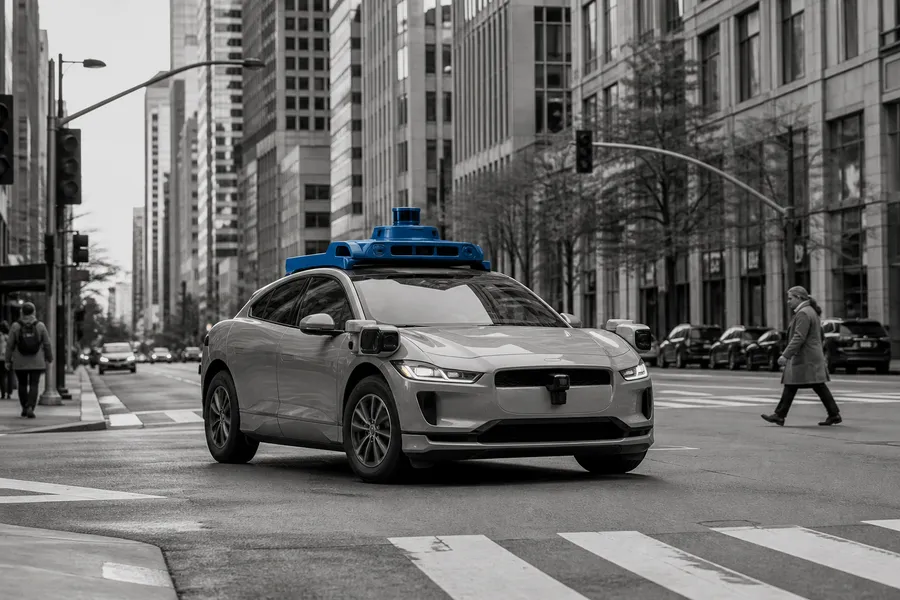
Alphabet’s autonomous-vehicle unit Waymo plans to quintuple its robotaxi fleet to 20,000 vehicles by end-2027, funded by $5 billion in newly raised private-credit debt, a scope of expansion that sharpens competitive pressure on Tesla, Uber, and rival AV developers.
For Alphabet (GOOGL) investors, the build-out marks a pivotal shift from R&D spend to capital-intensive commercial scaling – a transition that will test whether robotaxi unit economics can justify the infrastructure outlay before better-capitalised challengers close the technology gap.1
Key Takeaways
- Fleet to double to 8,000 vehicles by end-2026, then hit 20,000 by end-2027.
- $5 billion raised via non-recourse private-credit debt, no Alphabet guarantee.
- Thousands of Chinese-made Zeekr (Geely) vehicles already on order.
Market Reaction & Context
Waymo currently operates roughly 4,000 robotaxis across a handful of U.S. cities – a fleet that, even at today’s size, dwarfs publicly disclosed deployments by General Motors’ Cruise unit and Amazon-backed Zoox.1 The planned expansion to 20,000 vehicles would represent a scale previously unseen in the commercial autonomous-vehicle sector and would vault Waymo into territory where ride-hailing giants Uber and Lyft could face material route competition in key urban markets.2
Alphabet shares were in focus Monday following the Semafor report, as investors assessed both the growth ambition and the debt structure chosen to finance it. Because the $5 billion facility is non-recourse – meaning Alphabet itself has not guaranteed the borrowing – the parent company’s balance sheet carries less direct risk, though equity holders retain full exposure to operational execution.1
Detailed Analysis
The financing structure is notable for what it signals about Waymo’s stand-alone credit profile. Private-credit lenders extending $5 billion without a corporate guarantee from one of the world’s largest technology companies implies confidence in the underlying asset base – primarily the vehicles themselves – as collateral.2 Semafor reported that future lease securitisation of the fleet could unlock additional borrowing capacity, suggesting Waymo is building a capital-markets infrastructure more typical of an asset-heavy transportation company than a software-led startup.
Vehicle sourcing adds a geopolitical dimension to the story. Thousands of Zeekr-branded cars manufactured by China’s Geely are reportedly on order to support the ramp, a supply-chain decision that could attract regulatory scrutiny given Washington’s ongoing review of Chinese-made connected vehicles.2 Any disruption to that supply chain would directly threaten the fleet-doubling target for end-2026.
Expansion Roadmap
Waymo currently serves a limited set of U.S. markets and is eyeing a total of 15 domestic cities, with Toronto identified as the next international destination, according to Semafor’s sources.2 The two-stage growth plan – 8,000 vehicles by December 2026, then 20,000 by December 2027 – implies an annualised production and deployment rate that would stress even well-established automotive logistics networks.
The pace of city-by-city rollout will hinge on regulatory approvals that vary by jurisdiction, a variable that has historically been the single largest constraint on AV commercialisation timelines across the industry.
Outlook
Waymo has not publicly commented on the Semafor report, and Alphabet has not issued formal guidance tied to the fleet targets. However, the fundraising and reported supply agreements indicate that internal planning is sufficiently advanced to commit capital at scale.1 Analysts tracking the autonomous-vehicle sector have noted that reaching 20,000 operational robotaxis would generate ride data volumes large enough to meaningfully accelerate machine-learning model improvements – creating a compounding advantage over smaller-fleet rivals.
Whether the unit-economics pencil out at that scale remains the central question for Alphabet shareholders monitoring the investment thesis. Waymo’s ability to convert fleet size into sustainable per-ride margins – rather than simply top-line trip volume – will determine how the market ultimately values what remains a privately held subsidiary within Alphabet’s portfolio.
Not investment advice. For informational purposes only.
References
1(October 19, 2026). “Waymo plans to quintuple fleet to 20,000, Semafor reports”. Reuters. Retrieved October 20, 2026.
2Alexis Dufresne (October 20, 2026). “Waymo Targets 8K Robotaxis by Year-End and 20K by End of 2027, Backed by $5B Non-Recourse Debt”. AI Weekly. Retrieved October 20, 2026.