
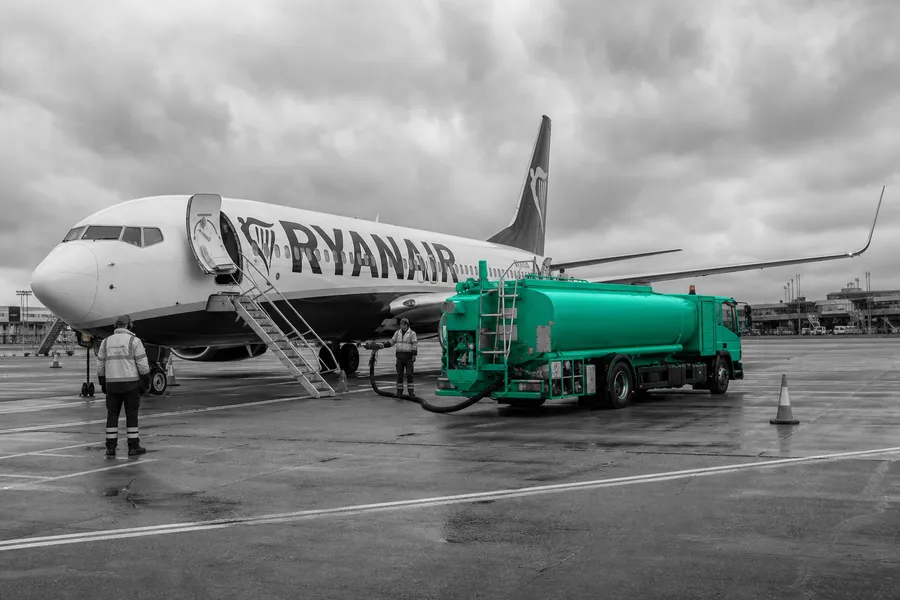
Ryanair (RYA.IR) shares fell 4% at Monday’s open after Europe’s largest low-cost carrier flagged flat summer fares and surging unhedged jet-fuel costs tied to the ongoing US-Iran conflict, raising double-digit consensus earnings-cut risk for fiscal 2027.
For macro and sector investors, the warning reframes Ryanair from a post-pandemic earnings compounder into a near-term margin story where fuel-hedge expiry timing and booking-curve length have become the critical variables.
Key Takeaways
- Summer fares turned flat; prior guidance called for low single-digit growth.
- Global jet-fuel spot prices spiked above $150 per barrel amid Hormuz disruption.
- 80% of FY27 fuel hedged at ~$67/bbl, shielding near-term but not full-year costs.
Market Reaction & Context
Ryanair shares dropped 4% at the Dublin open on May 18, underperforming the broader FTSE 100, which edged up 0.27% on the same session. 1 The selloff mirrors sector-wide nervousness: rival British Airways owner IAG has separately sought to reassure investors on jet-fuel supply continuity, signalling the pressure is industry-wide rather than carrier-specific.
Spot jet fuel at more than $150 per barrel represents a near-doubling versus pre-conflict norms and compares unfavourably with Ryanair’s locked-in hedge rate of approximately $67 per barrel – a spread that benefits the carrier only on the 80% of FY27 volume already hedged. 1 The remaining 20% is fully exposed to the spot market, a meaningful drag as summer approaches.
Detailed Analysis
Ryanair’s annual results for the year ended March 2026 showed after-tax profit (PAT) of €2.26 billion (£1.97 billion), a 40% year-on-year lift that edged ahead of analyst forecasts. 1 That backward-looking beat has been overshadowed by the forward guidance – or deliberate absence of it.
The carrier said it cannot provide any meaningful full-year FY27 profit guidance, citing “zero H2 visibility and significant fuel price/potential supply volatility.” 1 Pricing for the critical July-to-September quarter, which typically generates the bulk of annual earnings, has already stalled at flat versus the earlier expectation of low single-digit fare growth.
The root cause is Iran’s effective closure of the Strait of Hormuz following the outbreak of the US-Iran conflict, which has disrupted normal flows of crude and refined products globally. 1 Ryanair said Europe remains relatively well supplied with jet fuel sourced from West Africa, the Americas and Norway, and has consistently maintained it foresees no schedule disruptions – a distinction that matters for load-factor planning even as the margin outlook deteriorates. Separately, Ryanair’s operational resilience has faced scrutiny related to its Boeing 737 fleet, adding another layer of complexity for investors assessing the carrier’s cost base.
A later bookings curve since the conflict began is amplifying demand risk. Conroy Gaynor, consumer analyst at Bloomberg Intelligence, said Ryanair’s “weaker fares commentary suggests net income consensus for the fiscal year ending March 2027 could fall by a double-digit percentage despite its 4Q26 beat and better fuel hedging than peers.” 1 Gaynor also flagged rising environmental costs and the spike in unhedged fuel prices as additional margin pressures.
Competitive Positioning & Hedge Advantage
Despite the headwinds, Ryanair’s hedging strategy – 80% of FY27 jet fuel locked at roughly $67 per barrel through April 2027 – gives it a structural cost advantage over European rivals with lighter hedge books. 1 At spot prices above $150 per barrel, that differential is worth several hundred basis points of operating margin relative to less-hedged peers, a dynamic that could accelerate market-share gains if weaker carriers reduce capacity.
The airline’s conservative hedging philosophy has historically been a point of competitive differentiation, and management appears to be leaning on it again as a buffer. Whether the cushion is sufficient to absorb flat fares across peak season remains the central investor debate heading into Q1 FY27 reporting.
Outlook & Management Commentary
“The conflict in the Middle East has created economic uncertainty and we still don’t know when the Strait of Hormuz will reopen,” Ryanair said in its annual results statement. “Global jet fuel spot prices have spiked to over $150 [per barrel] and are expected to remain elevated versus pre-conflict levels for some months.” 1
Separately, Ryanair disclosed that contract discussions with group chief executive Michael O’Leary are “almost concluded,” with a proposed extension to 2032 that includes a purchase option over 10 million shares struck at pre-conflict market prices, exercisable only on achievement of “very ambitious” PAT or share-price growth targets. 1 The structure aligns management incentives tightly with long-run shareholder value, but the targets presuppose a material earnings recovery from current depressed levels.
Conclusion
Ryanair enters its peak trading season with a record FY26 PAT in hand but facing a confluence of geopolitical, cost and demand headwinds that has stripped out forward earnings visibility entirely. The key variables to monitor are the timeline for Strait of Hormuz reopening, the evolution of summer booking curves into July, and the pace at which the 20% unhedged fuel exposure translates into reported costs.
Until clarity emerges on at least one of those three fronts, analysts at Bloomberg Intelligence suggest the street’s FY27 consensus faces material downside revision risk – making RYA.IR a story of hedge-book arithmetic rather than demand fundamentals for the near term.
Not investment advice. For informational purposes only.
References
1Sky News / Yahoo Finance (18 May 2026). “Ryanair warns flat fares may weigh on profits”. Yahoo Finance UK. Retrieved 20 July 2026.
2Russell, M. (29 January 2024). “Ryanair Sees 93% Profit Drop Due To Rising Fuel Costs”. Simple Flying. Retrieved 20 July 2026.