
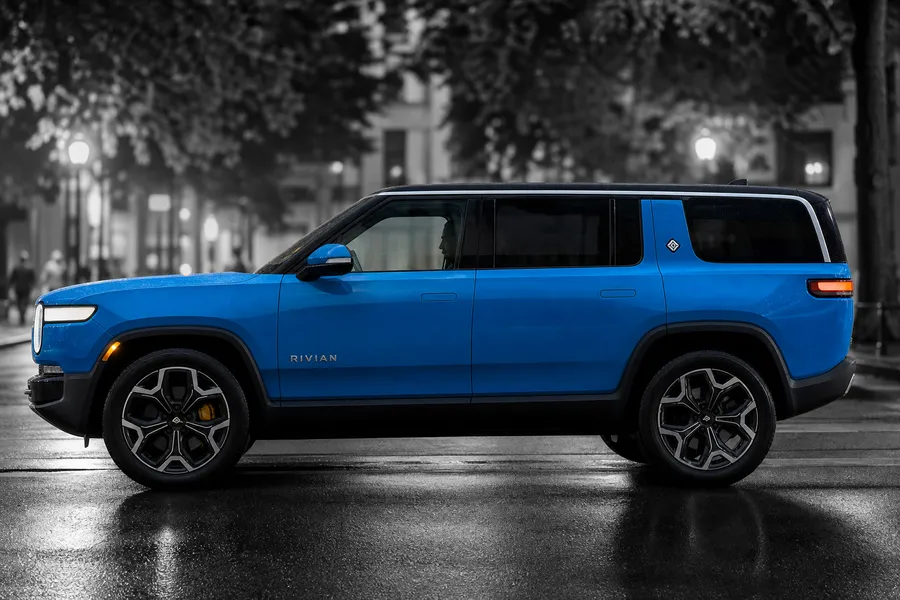
Rivian (RIVN) CEO RJ Scaringe said the company will release a supervised point-to-point self-driving feature for its Gen 2 vehicles later in 2026, putting it on a direct collision course with Tesla’s (TSLA) Full Self-Driving software in the fast-expanding autonomous-driving market.
For retail investors watching Rivian’s path to profitability, the autonomous-driving push matters because recurring software revenue – modeled on Tesla’s FSD subscription – could provide a high-margin layer atop vehicle sales that the company still needs to prove out.
Key Takeaways
- Rivian targets supervised point-to-point driving for Gen 2 vehicles in 2026.
- A lidar-equipped R2 crossover is expected to sharpen data quality further.
- Rivian is pricing its Autonomy+ at $2,500 or roughly $50 per month.
Market Reaction & Context
RIVN has trailed both Tesla and the broader EV peer group on software-capability narratives, a gap that has weighed on sentiment even as the company has made progress on vehicle production. Tesla’s FSD (Supervised) remains the only city-to-city automated-driving system commercially available in the United States, giving TSLA a significant first-mover advantage in software attach rates and the fleet data needed to improve the underlying model 1.
Rivian’s proposed $2,500 one-time or approximately $50-per-month pricing sits well below Tesla’s current FSD offering, a deliberate positioning that could attract early adopters if the feature performs comparably 2.
Detailed Analysis
Scaringe’s comments, made in a widely circulated interview, outlined a three-stage roadmap: hands-free highway driving (already live via Universal Hands-Free on 3.5 million miles of roads), point-to-point supervised driving later this year, and eventually an eyes-off, hands-off Level 4 capability in select conditions 3.
The technology underpinning the feature is Rivian’s proprietary “Large Driving Model” (LDM), an end-to-end AI architecture trained on customer fleet data – conceptually similar to the approach Tesla uses for FSD.
“Today on an R1 you can get on the highway and take your hands off the wheel, and the vehicle drives itself. That’s going to expand from highways to point-to-point so you get in your car in your driveway, put in an address, and it drives itself. Then we expand from there to not just hands off point-to-point, but hands off, eyes off where you can take your hands off the wheel and eyes off the road,”
Scaringe said in an Inc. magazine interview published in May 2025 3.
A journalist test ride conducted by InsideEVs in late 2025 found Rivian’s pre-release demo largely smooth – the R1S navigated traffic lights, lane changes, and turns without driver input – though minor hesitation events around pedestrians were noted 1.
Nick Carlevaris-Bianco, Rivian’s senior director of perception, said speed-bump handling and traffic-light compliance emerged organically from training data rather than explicit coding, a hallmark of end-to-end model design. The approach is powerful but also requires careful curation; the team had to actively train out rolling stop signs and aggressive acceleration on open roads observed in raw customer data.
Outlook & Competitive Positioning
The lidar-equipped R2 crossover, slated for late 2026, is expected to be the real inflection point: lidar delivers richer perception data that should both improve real-world performance and accelerate LDM training. Analysts note that Rivian’s fleet – smaller than Tesla’s by an order of magnitude – remains the primary structural disadvantage when it comes to the data arms race that underpins modern autonomous-driving development.
Community reaction has been skeptical in places, with some Tesla owners arguing Rivian lacks the multi-year dataset advantage that has allowed FSD to improve at pace. One commenter on a Rivian enthusiast forum noted, “I’m highly skeptical they can catch up to Tesla’s FSD that quickly,” echoing a broader market view that the timeline is ambitious 4.
Conclusion
Rivian’s Autonomy+ roadmap represents a credible, if still unproven, attempt to close the autonomous-driving gap with Tesla and add a recurring-revenue stream to its business model. Whether the LDM can reach parity with a system backed by millions of additional training miles remains the key execution risk for investors monitoring RIVN’s longer-term software story.
Not investment advice. For informational purposes only.
References
1Tim Levin (December 31, 2025). “I Got A Sneak Peek At Rivian’s Answer To Tesla Full Self-Driving”. InsideEVs. Retrieved June 15, 2026.
2Tdp Alpha (December 14, 2025). “What do we think rivian FSD pricing $2500 or $50 a month”. Tesla Model Y Owners Worldwide (Facebook Group). Retrieved June 15, 2026.
3Katsudon (May 12, 2025). “RJ: Rivian ADAS will expand to Tesla style FSD – full self driving on highway and roads (from driveway to destination)”. Rivian Forums. Retrieved June 15, 2026.
4DennisCW (June 14, 2026). “Rivian CEO Gives BIG Update to Autonomy+ (FSD Competitor)”. YouTube. Retrieved June 15, 2026.