
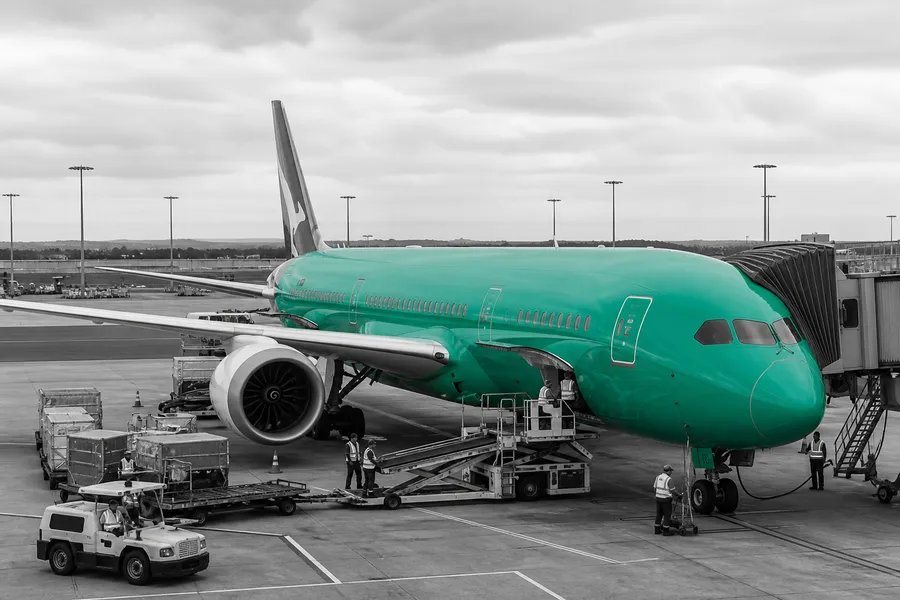
Airport workers at Qantas Airways (QAN.AX) walked off the job Thursday across Sydney, Brisbane, Adelaide and Perth in a 24-hour strike over pay, job security and safety, adding fresh operational risk to an airline already carrying a record A$90 million court penalty.
For shareholders, the stoppage compounds cost and reputational pressures at a carrier still working through the legal and financial fallout of its 2020 illegal outsourcing of ground staff – a dispute that has weighed on labour relations for six years.1
Key Takeaways
- 24-hour strikes hit four major Australian airports Thursday.
- Workers cite pay gaps, fragmented subsidiaries and safety failures.
- Qantas faces A$90 million penalty from prior illegal outsourcing ruling.
Market Reaction & Context
Qantas has not publicly quantified its wage offer, making it difficult to model the direct earnings impact of a settlement.2 The industrial action spans Qantas Ground Services (QGS), Australian air Express (AAE) freight operations and regional carrier QantasLink – units that collectively underpin the airline’s domestic and freight network.
Australian airline stocks have broadly tracked global aviation peers higher in 2026, but recurring labour disruptions have historically depressed load factors and lifted unit costs. A prolonged dispute could pressure QAN.AX at a time when the sector is sensitive to margin compression from wage inflation.
Detailed Analysis
The Transport Workers’ Union (TWU) said striking employees are seeking pay increases in line with industry standards, more full-time positions and consolidation of multiple subsidiary arrangements into a single Qantas enterprise structure.1 According to the Australian Council of Trade Unions, Qantas had by 2023 split its workforce across 21 external companies and 17 subsidiaries – a fragmentation workers argue has weakened both pay floors and safety oversight.
Current base pay for ground workers runs at approximately A$26-A$30 per hour – close to minimum wage – while the official cost of living has risen 31.4% over the past decade against wage increases of only 19.4-25.6% for the cohort.2 Median capital city rents over the same period jumped 45%, sharpening the real-income squeeze.
In Sydney, the action is further amplified by up to 400 safety screeners conducting two sets of two-hour stoppages Thursday, with a further three-hour stoppage planned for September 28.1 The TWU said the strike received a 97% vote mandate in late August, signalling deep workforce discontent.
The dispute carries significant legal backstory. Qantas outsourced more than 1,800 ground-handling roles during the COVID-19 pandemic in action later ruled illegal by Australian courts. A federal court last year imposed a A$90 million ($64 million) civil penalty – a record for such a breach – and ordered a A$120 million worker compensation scheme averaging roughly A$66,000 per affected employee.2
Management Quote
“Strike action is always a last resort, but we are literally seeing workers maimed and killed keeping these critical services going,” TWU National Secretary Michael Kaine said.1
Qantas did not respond to a request for comment on Thursday’s industrial action. The union called for what it described as a “fundamental reset” of the airline’s labour structure after years of cost-cutting through subsidiary arrangements.
Outlook
Whether the stoppage escalates depends on whether Qantas tables a revised offer before September 28, when the additional Sydney screener action is planned. Analysts monitoring QAN.AX will be watching for any guidance update on labour costs in the airline’s next earnings communication.
For macro and sector investors, the Qantas dispute is part of a broader wave of aviation labour activism globally, with parallel actions at Jetstar, Network Aviation and among Qantas long-haul pilots all proceeding under separate enterprise bargaining tracks – each isolated by union structure but reflecting the same underlying wage pressure.2
Conclusion
The 24-hour strike adds near-term operational uncertainty to Qantas’s domestic and freight network while reinforcing the longer-term risk that unresolved workforce fragmentation could trigger further, larger stoppages. Investors in QAN.AX should monitor any management response on wage settlement timelines and the September 28 Sydney follow-on action as leading indicators of whether the dispute broadens.
Not investment advice. For informational purposes only.
References
1Reuters (September 24, 2026). “Qantas workers begin 24-hour strike at four Australian airports, union says”. Reuters. Retrieved September 24, 2026.
2(September 22, 2026). “Australia: Qantas ground workers set to strike”. World Socialist Web Site. Retrieved September 24, 2026.