
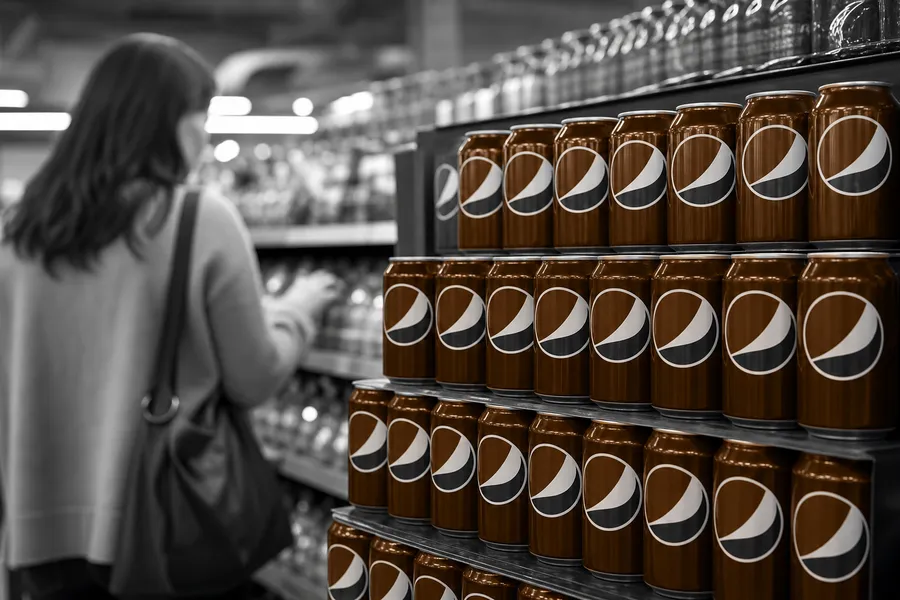
PepsiCo (PEP.O) fell roughly 5% on Thursday after second-quarter core earnings per share of $2.20 missed analyst expectations, with North American food sales down 2% and management flagging steeper commodity inflation ahead.
The earnings shortfall and cost warning matter because they signal that PepsiCo’s two-year effort to reclaim volume through price cuts on Lay’s, Doritos and other flagship brands is moving more slowly than the market had priced in, pressuring the near-term margin outlook.
Key Takeaways
- Q2 core EPS of $2.20 missed estimates; shares fell ~5%.
- North America food sales fell 2%; beverage volumes down 4%.
- Higher H2 commodity costs flagged despite full-year guidance held.
Market Reaction & Context
The roughly 5% share decline places PepsiCo among the weakest performers in the S&P 500 Consumer Staples sector on the day, a stark contrast to international peers that have benefited from stronger emerging-market demand in 2026 1. The stock had already underperformed the broader staples index over the prior 12 months as persistent North American softness weighed on sentiment.
Quarterly revenue rose 6.4% year-on-year to $24.18 billion, beating the consensus estimate of $23.95 billion compiled by LSEG, driven largely by international snack and beverage volumes 2. Global food volumes grew 3% and beverage volumes grew 2%, but those gains were almost entirely sourced outside North America.
Detailed Analysis
North American beverage volumes contracted 4% in the quarter, while the food segment – home to Frito-Lay brands – posted flat volumes and a 2% decline in net sales, reflecting the impact of lower effective net pricing as the company pursued its value-recovery strategy 1. CFO Steve Schmitt said the North America business was softer than expected and that improvement in performance trends would likely be “more gradual” through the rest of the year 2.
High gasoline prices, tied in part to tensions stemming from the Iran conflict, dented on-the-go snack and beverage consumption more than PepsiCo had anticipated going into the quarter 1. Rising packaging and logistics costs compound the problem, squeezing the margin buffer that productivity savings and tariff refund claims are expected to only partially offset in the second half.
PepsiCo had cut prices on Lay’s, Tostitos, Doritos and Cheetos by up to 15% in North America earlier this year to arrest a share-loss trend toward private-label and smaller pack sizes 2. That promotional posture suppressed net pricing even as volumes failed to recover materially, a combination that erodes operating leverage.
Outlook & Management Comment
CEO Ramon Laguarta credited portfolio evolution and international strength for positive organic volume growth, but acknowledged that tighter consumer budgets and inflationary pressures tempered the overall result 1. The company kept its full-year forecast unchanged, targeting organic revenue growth of 2%-4% and core constant-currency EPS growth of 4%-6%.
Schmitt said North American advertising and marketing spend is set to rise in the second half, framing it as an offensive move. “We’re going to continue to play offense,” he said on the analyst call 1.
PepsiCo is also refreshing its portfolio toward health-oriented products – including Gatorade Lower Sugar, Propel powder and Quaker Protein Rice Crisps – to align with shifting consumer preferences 1. eMarketer analyst Suzy Davidkhanian framed the longer-term challenge succinctly:
“Consumers are still spending, but they’re becoming more intentional about where they spend, and they expect the brands they already know to evolve with them by giving them more choice.” 1
Conclusion
PepsiCo’s second quarter illustrates the difficult trade-off facing large consumer staples companies: cutting prices to defend volume erodes margins at the same moment commodity costs are re-accelerating. With North American volumes still under pressure and the cost curve moving unfavorably, the path to the upper end of full-year guidance appears narrow.
Net income attributable to PepsiCo climbed to $2.98 billion, or $2.18 per share, from $1.26 billion a year earlier, though the year-ago figure was depressed by one-time items, making the comparison flattering on a headline basis 2. Investors will be watching second-half volume data closely to determine whether the marketing investment and price adjustments are beginning to restore North American momentum.
Not investment advice. For informational purposes only.
References
1Anuja Bharat Mistry and Alexander Marrow (July 9, 2026). “PepsiCo warns of higher commodity costs amid faltering North American food sales”. Reuters. Retrieved July 9, 2026.
2(July 9, 2026). “PepsiCo earnings miss estimates as North America demand weakens”. ANews. Retrieved July 9, 2026.
3CNBC (July 9, 2026). “PepsiCo earnings miss estimates as North American consumers tighten their budgets”. X (formerly Twitter). Retrieved July 9, 2026.