
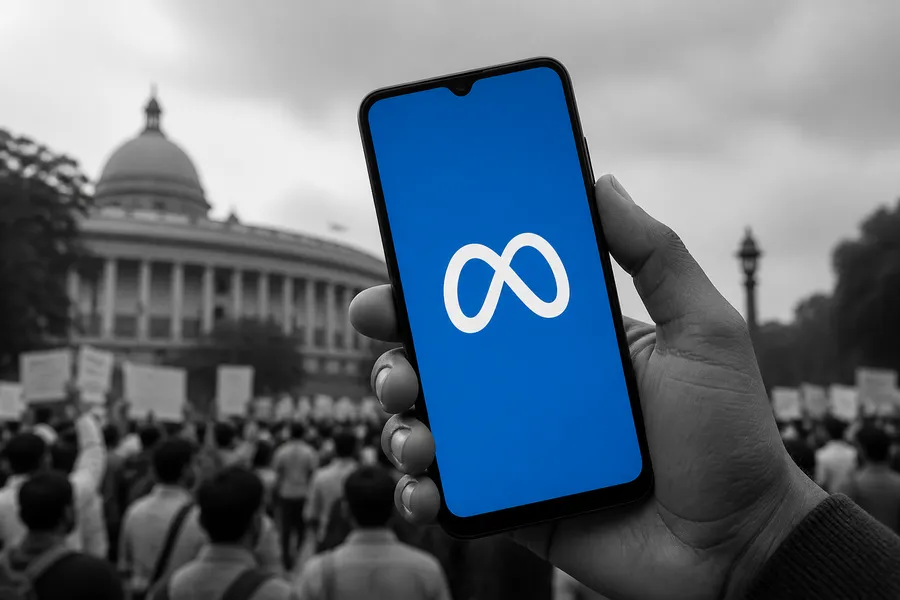
Meta Platforms (META) cemented its position as India’s dominant social-media operator in July 2026, with Instagram daily active users surging 16% year-on-year to 531 million during peak Gen Z protests, a scale that analysts say is simultaneously its greatest emerging-market asset and its sharpest regulatory liability.
India’s advertising market is one of the last large pools of digital-ad revenue where Meta has room to grow per-user monetisation, making the outcome of escalating government scrutiny a material variable for long-run earnings trajectories. 1
Key Takeaways
- Instagram DAUs hit 531 million in India during July protests, up 16% YoY.
- India’s IT ministry summoned Meta’s global policy heads over compliance failures.
- India is “strategically” critical for Meta, but financially immaterial today.
Market Context & Competitive Positioning
According to digital-intelligence provider Sensor Tower, Meta’s three platforms – WhatsApp (837 million average daily active users so far in 2026), Instagram (501 million) and Facebook (362 million) – dwarf every rival in India. 1 Alphabet’s (GOOGL) YouTube sits at 646 million daily active users, while Elon Musk’s X trails the field at just 15 million, underscoring Meta’s structural lock on the country’s social-media stack.
The protest-driven engagement spike was platform-specific: Instagram’s daily active users climbed 2.6% sequentially between July 18 and July 26, while Facebook, YouTube and WhatsApp saw usage remain largely flat over the same window. 1 That divergence reinforces a thesis among analysts that Instagram’s short-form video format is pulling India’s digital-political conversation away from legacy news outlets and older platforms.
Detailed Analysis: The Double-Edged Sword
The catalyst was a wave of student demonstrations organised by the viral Cockroach Janta Party (CJP) movement, which used Instagram extensively to coordinate protests and document clashes with authorities. 1 Prime Minister Narendra Modi’s government ultimately conceded to protesters’ core demands, including the resignation of Education Minister Dharmendra Pradhan over exam paper-leak allegations.
Modi himself signalled Instagram’s political weight when he posted his first selfie-style reel on July 23; the video crossed 300 million views within 24 hours and is approaching 400 million. 1 He subsequently directed cabinet ministers to build their own Instagram presence – an endorsement of the platform that no rival has received from the Indian government’s highest level.
Yet the same visibility created friction. India’s information-technology ministry summoned Meta’s global policy heads over what it described as “non-compliance with the Information Technology Rules” and the spread of deepfakes on Instagram and Facebook. 1 The ministry also called Meta’s brief restriction of Modi’s Facebook video “disturbing,” with India’s IT secretary voicing the government’s displeasure in an interview with news agency ANI.
Earlier this month, regulators issued a formal warning to Instagram over child-abuse advertisements and separately cautioned WhatsApp about a username-rollout feature – indicating enforcement activity across Meta’s entire India portfolio, not just one app. 1 Analysts note the dynamic mirrors pressures Meta faces in Europe and the United States, meaning India adds a third regulatory front.
Analyst Outlook
Rohit Kulkarni, managing director and senior analyst at Roth Capital Partners, said:
“Instagram’s growing prominence, particularly among younger users and as a platform for public discourse, reinforces Meta’s dominant position in India’s digital ecosystem.”
Kulkarni added that India is “strategically” far more important to Meta today than it is financially, calling the country “one of Meta’s largest long-term monetisation opportunities.” 1 That gap between strategic value and current revenue contribution explains why the company faces an asymmetric risk: any punitive state action – such as usage restrictions or forced compliance costs – would damage future earnings potential more than near-term results.
Neil Shah, vice president of research at Counterpoint Research, said Meta has “raced ahead” and “is unparalleled” in social commerce, communication and ad targeting in India, with algorithmic personalisation giving its platforms a credibility advantage over homegrown challengers, none of which have gained meaningful traction. 1 India’s internet and smartphone user base is second only to China – a market that blocked U.S. social platforms more than a decade ago, erasing hundreds of millions of users and vast advertising revenue from American tech companies’ books.
Conclusion
For META shareholders, India’s trajectory is a long-duration option: the country contributes little to today’s revenue per user relative to North America or Europe, but a continued engagement ramp – and eventual monetisation lift – could represent a multi-billion-dollar earnings catalyst over the coming decade. 1 The near-term risk is that political centrality makes Meta a perpetual target for regulatory intervention, particularly in an environment where the government both depends on and resents the platforms it cannot easily replace. Investors in adjacent India-focused stories – such as the country’s growing consumer and IPO pipeline – may find Coca-Cola’s India IPO preparations a useful parallel for how U.S. multinationals are navigating New Delhi’s tightening regulatory gaze.
Not investment advice. For informational purposes only.
References
1Salve, Priyanka (2026-07-30). “Inside India newsletter: Meta’s clout in the world’s largest democracy is surging – inviting scrutiny”. CNBC. Retrieved 2026-07-30.
2(2026-07-30). “Inside India newsletter: Meta’s clout in the world’s largest democracy is surging – inviting scrutiny | CNBC”. LinkedIn/CNBC. Retrieved 2026-07-30.
3Salve, Priyanka (2026-07-30). “Inside India newsletter: Meta’s clout in the world’s largest democracy is surging – inviting scrutiny”. CNBC (AMP). Retrieved 2026-07-30.
4(2026-07-30). “Meta Platforms has strengthened its influence on India…”. CNBC Technology / Facebook. Retrieved 2026-07-30.
5(2026-07-30). “Inside India newsletter: Meta’s clout in the world’s largest democracy is surging – inviting scrutiny”. CNBC / Threads. Retrieved 2026-07-30.