
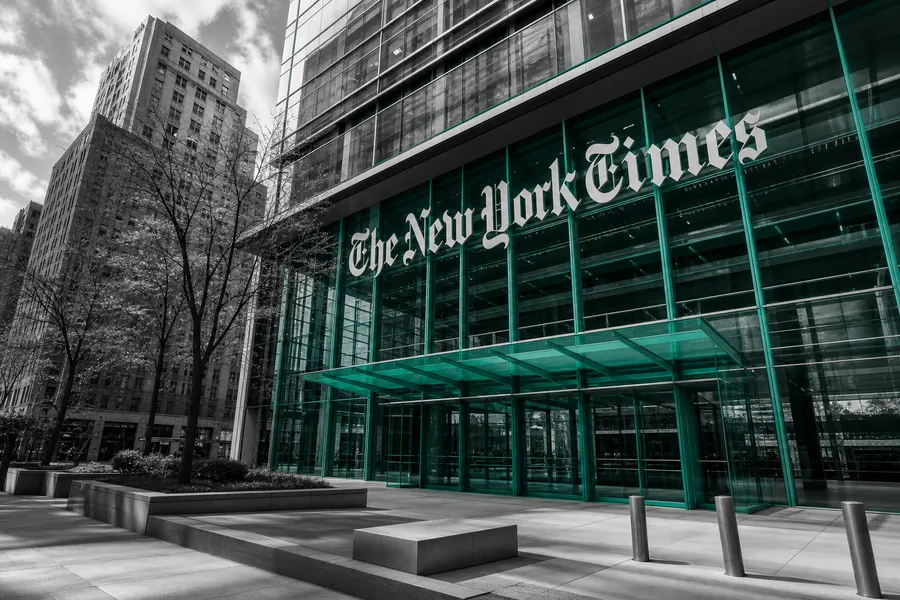
A Manhattan federal judge compelled the Justice Department to withdraw grand jury subpoenas targeting New York Times journalists on Thursday, in a rebuke that sharpens regulatory-risk concerns across the publicly traded media sector.
For investors monitoring governance and regulatory exposure at media companies, the episode illustrates how aggressive government action against newsrooms can generate legal costs, reputational overhang and chilling effects on editorial operations – all potential drags on subscriber retention and advertising revenue.
Key Takeaways
- DOJ withdrew subpoenas after judge cited procedural violations and First Amendment issues.
- Prosecutors admitted serving subpoenas before completing required investigative steps.
- DOJ said the leak investigation remains open; new subpoenas remain possible.
Regulatory Context & Sector Implications
The confrontation between the Justice Department and The New York Times Company centers on reporting about security shortcomings of the Qatar-donated Boeing 747-8 now serving as the presidential aircraft – a story that drew significant public attention to the roughly $400 million gifted aircraft and its retrofit costs. Media companies have faced growing regulatory risk tied to DOJ subpoena actions, and this case represents a rare instance of a court publicly halting that process mid-stream.
U.S. District Judge Arun Subramanian, presiding in the Southern District of New York, repeatedly pressed government prosecutors on whether they had followed the 2nd U.S. Circuit Court of Appeals’ three-part test before compelling journalist testimony. That test requires prosecutors to exhaust all alternative investigative steps first – a threshold the court found had not been met 1.
Procedural Breakdown & Admissions
Sean Buckley, chief counsel to the U.S. Attorney for the Southern District of New York, acknowledged in open court that the subpoenas were served before certain initial investigative steps were completed – a direct inversion of the legal sequence required under circuit precedent 2. Buckley also admitted the government had erroneously obtained phone records linked to reporters’ family members, including spouses and, in one instance, a reporter’s mother, after a public-source database produced incorrect matches.
“That was an error,” Buckley said. “It was a mistake; it was not in furtherance of the investigation.” The judge warned that the pattern of incorrect and incomplete court submissions could warrant sanctions, noting he would ordinarily require parties to show cause in a comparable civil proceeding 1.
The DOJ’s Pushback and Forward Risk
Despite withdrawing the subpoenas, the Justice Department issued a statement rebuking the judge and making clear the underlying leak probe continues. “This judge threatened our attorneys with sanctions unless subpoenas were withdrawn, and blocked us from presenting the meticulous process of this investigation,” the DOJ said, adding: “Make no mistake, this investigation remains ongoing, and we will pursue justice against those threatening national security by leaking classified information, a serious federal crime.” 2
Prosecutors reserved the right to return to court with new subpoenas, and Buckley said the government is prepared to immunize reporters – compelling testimony by removing their Fifth Amendment exposure – should new applications be granted. That prospect keeps legal and editorial risk elevated for the Times and potentially for other major news organizations operating under similar government scrutiny.
Times Response and Broader Media Read-Through
David McGraw, the Times’ senior vice president and deputy general counsel, called the DOJ’s retreat “an important affirmation of our country’s commitment to a free press,” while adding that the subpoenas “should never have been issued in the first place.” 1 Times attorney David O’Neil argued the subpoenas had already produced a measurable chilling effect on reporters, a factor relevant to assessing the operational cost of government pressure campaigns on editorial organizations.
For macro-focused investors, the case underscores that government-media friction is not merely reputational noise – it carries direct cost implications via litigation, resource diversion and potential source attrition that can constrain investigative capacity and, over time, differentiated content value 3.
Conclusion
Thursday’s courtroom outcome represents a procedural win for press-freedom norms, but the DOJ’s explicit reservation of the right to refile keeps the legal overhang in place. Investors in publicly traded media names should monitor whether the government pursues new, procedurally compliant subpoenas – an outcome the court said it would evaluate on its merits – as a signal of sustained regulatory pressure on the sector 4.
Not investment advice. For informational purposes only.
References
1Adam Reiss, Alexandra Marquez (2026-07-23). “Justice Department agrees to withdraw subpoenas of New York Times journalists over Air Force One reporting”. NBC News. Retrieved 2026-07-24.
2(2026-07-23). “DOJ agrees to withdraw subpoenas for New York Times journalists”. ABC News. Retrieved 2026-07-24.
3Salvador Rizzo (2026-07-23). “Justice Department agrees to withdraw subpoenas to New York Times reporters”. The Washington Post. Retrieved 2026-07-24.
4(2026-07-11). “Times Journalists Subpoenaed as Trump Escalates Pressure on Media”. The New York Times. Retrieved 2026-07-24.