
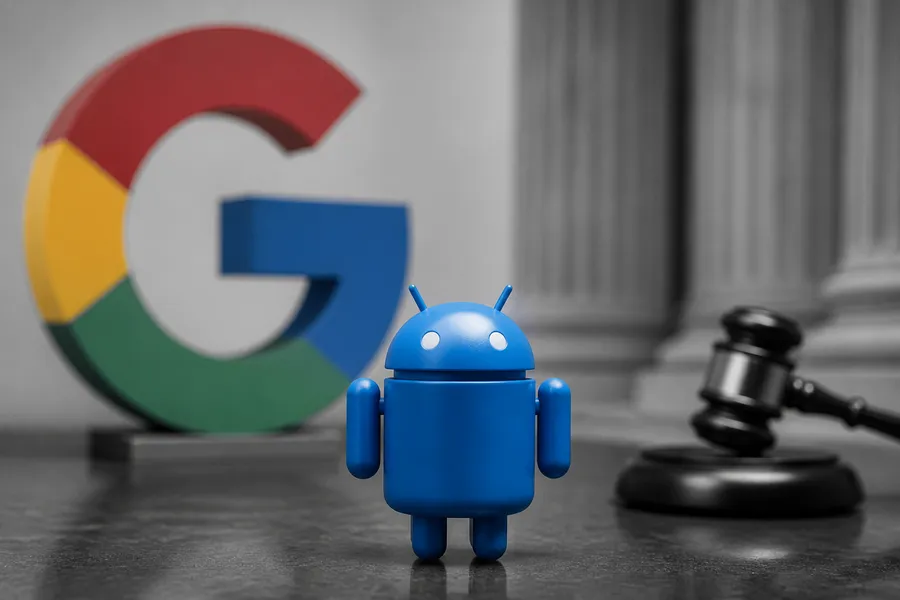
Alphabet (GOOGL) escalated its regulatory battle Monday, filing court appeals against EU orders requiring Android to open up and search data to be shared with rivals – a dispute that could reshape the company’s European revenue base.
Investors in GOOGL face a two-front legal risk: adverse rulings could force structural changes to Android’s distribution model and erode the data moat that underpins Google’s dominant search-advertising business, which generated the bulk of Alphabet’s $307 billion in 2025 revenue.
Key Takeaways
- Google appealed two EU binding orders covering Android and search data.
- Rulings could force rivals access to core Google platforms and data.
- Legal outcomes threaten Alphabet’s European advertising revenue moat.
Market Reaction & Context
Google filed the appeals with the EU General Court, the bloc’s second-highest judicial body, challenging binding instructions issued under the Digital Markets Act (DMA) – the sweeping legislation that designates large platforms as “gatekeepers” subject to interoperability and data-sharing obligations 1. Alphabet shares were little changed in early Asian trading Monday, broadly in line with the flat Nasdaq Composite, though analysts cautioned that a loss at the General Court could invite further enforcement actions and fines running into billions of euros.
The DMA gatekeeper framework has already drawn legal challenges from Apple (AAPL) and Meta Platforms (META), making Google’s move part of a broader Big Tech pushback against Brussels. Unlike antitrust cases that can drag for over a decade, DMA enforcement timelines are compressed, heightening near-term compliance risk for all three companies.
Detailed Analysis
The first appeal targets EU instructions to open Android – the world’s most widely used mobile operating system – to competing AI services and default-app alternatives, a mandate that strikes at the commercial arrangements Google uses to pre-install Search and its AI assistant on billions of devices globally 1. If the court upholds the order, handset makers could be required to offer rival AI tools at the same prominence as Google’s, potentially fragmenting the on-device distribution channel that feeds the company’s advertising and cloud-services pipelines.
The second appeal concerns a demand that Google share search-query data with competing search engines, a requirement the company has publicly argued would compromise user privacy and security. For competitors such as Microsoft’s Bing or privacy-focused DuckDuckGo, access to Google’s query volume and click-through signals could meaningfully narrow the relevance gap that has kept Google’s global search-market share above 90% for years.
European Commission regulators have framed both measures as necessary to create “contestable and fair” digital markets. Google, for its part, has consistently argued that its products succeed on merit and that forced data-sharing creates new cybersecurity vulnerabilities.
Outlook & Management Position
Google said it filed the appeals because it believes the binding instructions go beyond what the DMA requires and could harm consumers by degrading the quality and security of its services 1.
The General Court process is expected to take several years, though interim measures could be sought by either side during that period. A final adverse ruling could be escalated further to the European Court of Justice, adding additional time and uncertainty to any resolution.
Conclusion
For macro and sector investors, the Google appeals represent a bellwether for how the EU’s DMA enforcement regime will ultimately be calibrated. A court victory for Brussels would set precedent accelerating compliance timelines across all designated gatekeepers; a Google win could blunt the DMA’s teeth and stabilise the competitive moat that Alphabet’s advertising model depends on. Either outcome will carry significant read-through for Alphabet’s European operating margins and for the broader digital-platform competitive landscape.
Not investment advice. For informational purposes only.
References
1(2026, September 29). “Google Appeals EU Requests on Android AI Access, Search Data Sharing”. The Wall Street Journal. Retrieved September 29, 2026.