
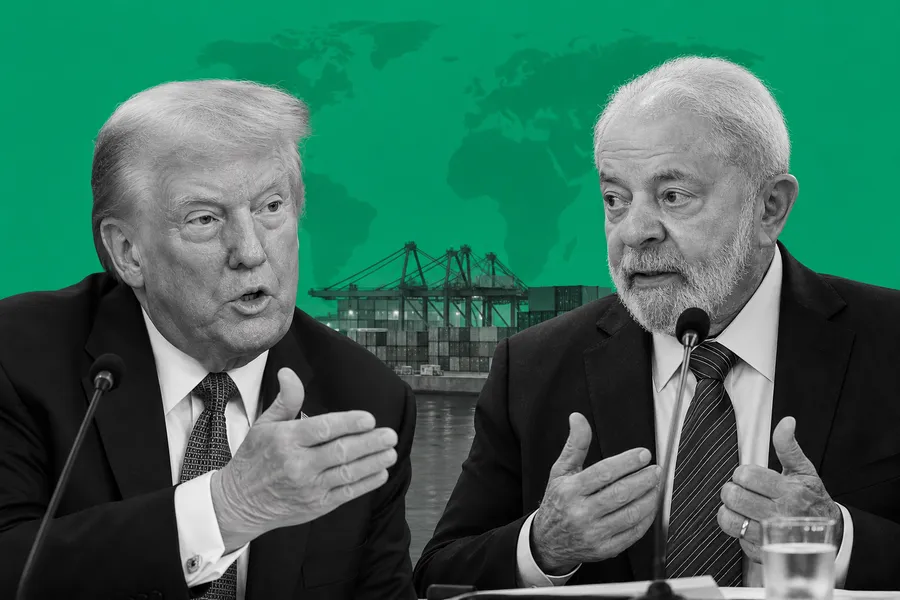
Washington confirmed a 25% Section 301 tariff on most Brazilian imports effective July 22, with a separate forced-labor probe threatening to stack an additional 12.5% duty within days – a combined potential rate of 37.5% that rivals the steepest levies applied to any major U.S. trading partner this year.
For investors exposed to Brazil-linked commodity flows, consumer goods supply chains, or emerging-market equities, the dual-track tariff structure introduces cost and repricing risk that could persist well beyond the October Brazilian presidential election.
Key Takeaways
- 25% tariff on most Brazilian goods takes effect July 22.
- A pending forced-labor ruling could add 12.5% on top.
- Beef, orange juice, aircraft, and energy goods are exempted.
Market Context & Scope
The 25% levy, authorized under Section 301 of the Trade Act of 1974, concludes a yearlong U.S. Trade Representative investigation into what Washington characterizes as unfair Brazilian trade practices 1. The rate sits materially above the baseline 10% global tariff that the Supreme Court left intact in February after striking down President Donald Trump’s earlier 50% Brazil levies – and is roughly in line with the broader tariff pressure the administration has applied to other trading partners through the same Section 301 mechanism 2.
Exempted categories – beef, orange juice, aircraft and parts, and energy products – reflect both domestic U.S. import-dependency and strategic sector carve-outs. Notably, the aircraft exemption limits direct exposure for Brazil’s Embraer, while U.S. importers of industrial and consumer goods face an immediate cost reset. Investors tracking aerospace supply-chain tariff risk may find useful parallel context in how Airbus has navigated demand and tariff pressures on its own order book.
What Triggered the Action
The USTR investigation cited a cluster of grievances: Brazilian court orders directing U.S. technology companies – including Meta Platforms (META.O), Alphabet’s Google (GOOGL.O), and X – to remove political content and suspend accounts of U.S. residents; preferential tariff arrangements Brazil extended to Mexico and India; weak intellectual property enforcement; and barriers to U.S. ethanol market access 1.
The administration also flagged inadequate enforcement of anti-deforestation laws, a point emphasized in the earlier June 2 proposal that first signaled the 25% rate 2. Months of high-level negotiations between Brazilian officials and USTR representatives failed to produce a settlement, with Secretary of State Marco Rubio saying President Luiz Inácio Lula da Silva’s government had
“not negotiated in good faith”
and that the tariffs were the price of Lula “putting his own ego ahead of making a deal.” 1
The 12.5% Wild Card
The more immediate market uncertainty lies in the forced-labor probe, which remains open and could deliver a ruling within days 1. If imposed, the stacked rate of 37.5% would represent one of the highest bilateral tariff ceilings Washington has set outside of China-specific actions – a threshold that commodity traders and importers of Brazilian manufactured goods will need to model into forward pricing.
Brazilian trade ministry officials did not respond to press requests for comment, leaving the door open for retaliatory measures or a last-minute negotiated pause 1. Senator Flávio Bolsonaro, whose Washington lobbying visit Lula accused of accelerating the tariffs, said he was working to persuade the Trump administration to delay implementation until after October’s presidential election – though no such delay has been granted.
Political Overlay and Investor Outlook
The tariff dispute has become embedded in Brazilian domestic politics ahead of the October 2026 presidential contest, adding a layer of policy-reversal optionality that investors may choose to price – or discount – depending on election polling trajectories 1. A change in government could alter Brazil’s posture on the underlying grievances, potentially opening a path to renegotiation.
For now, the operative assumption is that a 25% tariff floor is in place from July 22 and that the forced-labor decision represents the next binary catalyst. Sectors with significant Brazilian import exposure – industrial inputs, processed foods outside the exempted categories, and textiles – face the most immediate margin pressure until the regulatory picture clarifies.
Not investment advice. For informational purposes only.
References
1Anniek Bao (2026, July 16). “U.S. slaps 25% tariff on most Brazilian goods over ‘unfair trade practices'”. CNBC. Retrieved July 16, 2026.
2Daisuke Wakabayashi (2026, June 2). “Trump Targets Brazil With 25% Tariff, Citing Unfair Trade Practices”. The New York Times. Retrieved July 16, 2026.