
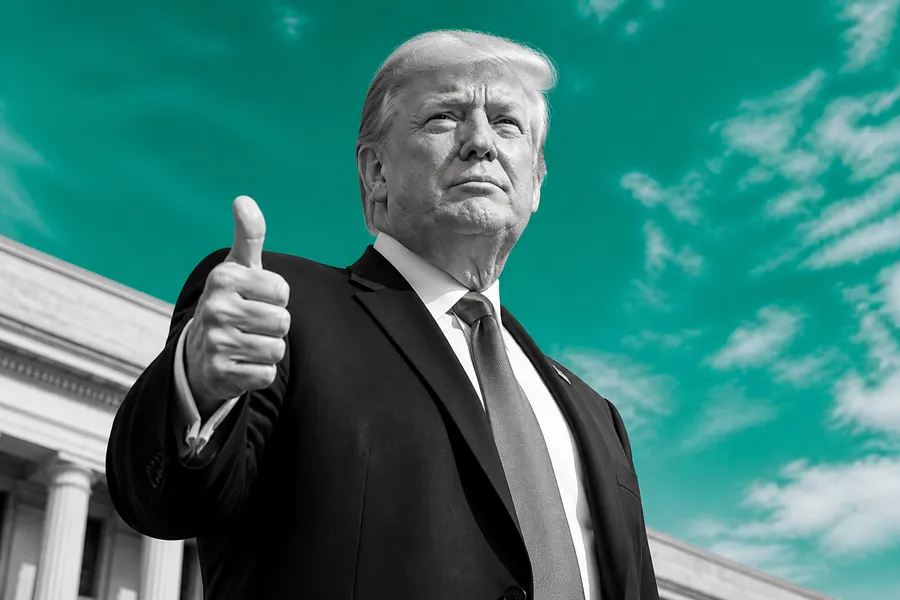
Capital One Financial (COF) disclosed Friday that anti-money-laundering specialists – not political bias – triggered the 2021 closure of more than 300 Trump Organization accounts, a first-of-its-kind formal bank admission that raises fresh compliance and litigation risk for the lender 1.
For COF shareholders, the disclosure sharpens the legal overhang: a Florida federal court has already dismissed two versions of the Trump Organization’s debanking lawsuit, yet plaintiffs continue to file amended complaints, keeping litigation costs and headline risk alive 2.
Key Takeaways
- Capital One cites AML review, not politics, for 300-plus account closures.
- First time any bank formally links AML concerns to Trump’s business.
- Florida court has dismissed two prior complaints; third now challenged.
Market Reaction & Context
COF shares slipped 0.54% on Friday, underperforming JPMorgan Chase (JPM), which edged higher on the session 2. The modest decline suggests markets are treating the disclosure as a manageable legal skirmish rather than a material earnings threat, consistent with how large-cap bank stocks have generally absorbed politically charged debanking headlines throughout 2025-2026.
The broader KBW Bank Index has climbed roughly 12% year-to-date as rate expectations stabilised, giving Capital One a supportive backdrop even as its compliance posture draws scrutiny. Deutsche Bank (DB) faced similar attention in prior years after reports that its own AML professionals flagged transactions linked to Trump-related accounts – allegations Deutsche Bank denied at the time 3.
The AML Rationale
Capital One’s court filing, submitted as part of a motion to dismiss, argues that internal documents and the plaintiffs’ own allegations confirm the closures stemmed from its AML team’s work, not from ideological motives 1. The bank said the process involved “months of analysis and a careful review by Capital One’s AML team in accordance with bank policies and regulatory guidance.” 1
Critically, Capital One has stopped short of accusing the Trump Organization of illegal money laundering. The filing said only that “the transaction patterns identified by Capital One are among the types of activity flagged by federal banking guidance” – language calibrated to justify the closures without triggering a separate legal liability 3.
Litigation Landscape
The Trump Organization and Eric Trump filed suit in a Florida federal court in March 2025, alleging Capital One acted on “woke” ideology and sought to capitalise on post-January 6 political sentiment 2. Capital One called those allegations “misguided” and “based on cherry-picked quotations unsupported by the full context” of submitted documents 1.
The Miami court has twice dismissed the complaint while allowing amended filings; Capital One’s latest motion targets the July 2026 version, arguing it “suffers from the same fundamental flaws” as its predecessors 3. A separate Trump suit against JPMorgan Chase, filed in January 2026 on comparable debanking grounds, signals that the administration’s legal pressure on Wall Street is unlikely to abate soon 2.
Regulatory & Policy Backdrop
President Trump signed an executive order in August 2025 barring financial institutions from denying services on political or religious grounds, framing debanking as a civil-liberties issue for conservative customers 1. That order puts large banks in a difficult compliance bind: AML regulations compel them to act on suspicious transaction patterns, while the executive order creates political – and potentially legal – exposure if those actions affect politically prominent clients.
The tension is not new. During Trump’s first term, in 2019, he sued both Capital One and Deutsche Bank to prevent them from handing financial records to Congress during a Democratic-led investigation 3. The current litigation cycle suggests that relationship remains adversarial, even as Capital One frames its conduct as routine regulatory compliance.
Outlook
“The closures were the result of months of analysis and a careful review by Capital One’s AML team in accordance with bank policies and regulatory guidance,” the bank said in its Friday filing 1.
Analysts will watch whether the Miami court grants dismissal of the third complaint, which would effectively end the case and remove an overhang from COF’s compliance narrative. A ruling that permits the lawsuit to proceed to discovery, however, could force Capital One to disclose further details about the transaction patterns it flagged – information that could itself become politically and legally sensitive.
Conclusion
Capital One’s AML disclosure marks a watershed moment in the broader debanking debate, formally linking compliance procedures to the closure of a politically prominent client’s accounts for the first time. For investors, the near-term COF story is one of contained litigation risk set against a constructive macro backdrop for bank stocks; the longer-term question is how financial institutions navigate an environment where AML obligations and executive-branch pressure increasingly pull in opposite directions.
Not investment advice. For informational purposes only.
References
1Reuters (2026-08-01). “Capital One says it closed Trump Organization’s accounts after anti-money-laundering review”. The Guardian. Retrieved 2026-08-02.
2Simon Mugo (2026-08-01). “Capital One says Trump Organization accounts closed after AML review”. Yahoo Finance / Investing.com. Retrieved 2026-08-02.
3Reuters (2026-08-01). “Capital One shuts Trump Organization’s accounts after anti-money laundering probe”. The Economic Times. Retrieved 2026-08-02.