
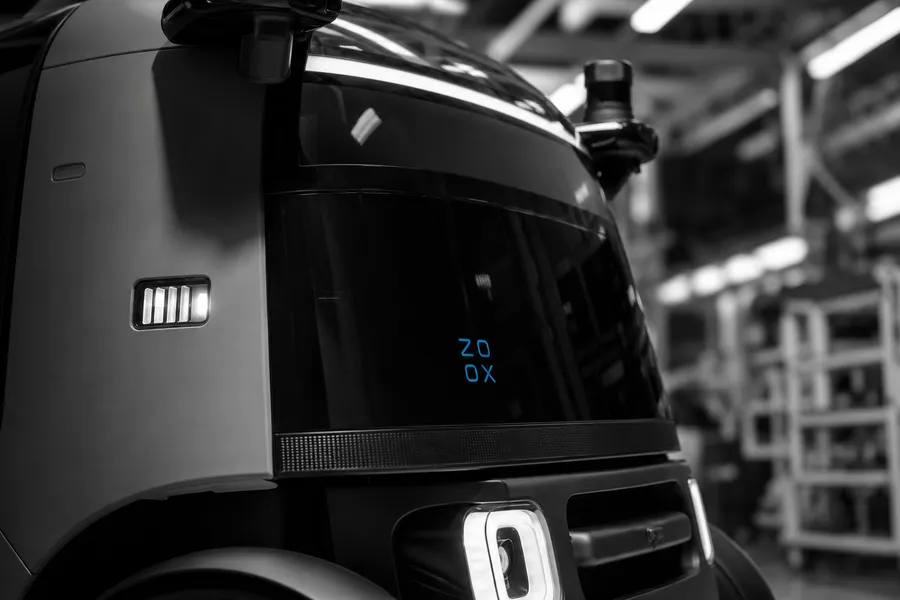
Amazon’s (AMZN) Zoox unveiled a redesigned driverless vehicle and expanded its testing footprint to ten U.S. cities, intensifying a competitive battle with Alphabet’s Waymo that has direct implications for Amazon’s long-term logistics ambitions.
For Amazon shareholders, the Zoox push represents a potential second revenue engine: the company has signalled plans to begin charging for rides in San Francisco and Las Vegas in 2026, converting a cost centre into a commercial service that could eventually integrate with Amazon’s delivery and cloud infrastructure.1
Key Takeaways
- Zoox now active in ten U.S. markets after adding Dallas and Phoenix.
- Redesigned vehicle adds comfort upgrades and clearer directional cues.
- Paid commercial rides in San Francisco and Las Vegas targeted for 2026.
Competitive Positioning Against Waymo and Tesla
Waymo, the clear U.S. market leader, is completing 450,000 paid rides per week as of early 2026 and operates in six cities after adding Miami in January.1 Zoox’s expansion to Dallas and Phoenix – markets Waymo has also earmarked for growth – signals that Amazon is willing to compete directly on geography rather than cede territory.
Tesla (TSLA), by contrast, has moved more cautiously: its robotaxi service launched in Austin and the San Francisco Bay Area in mid-2025, but still relies on human safety drivers in most vehicles.1 Zoox’s purpose-built vehicle – which carries no steering wheel and seats passengers face-to-face – has already received a National Highway Traffic Safety Administration exemption to operate on public roads, a regulatory milestone Tesla has not yet replicated in California.
What the Redesign Signals
The updated vehicle introduces more comfortable seats, integrated headrests, and repositioned bidirectional reflectors that make it easier for pedestrians and riders to distinguish the vehicle’s front from its rear – a subtle but operationally important change for urban environments.2 The redesign also suggests Zoox is preparing its fleet for higher-volume passenger use ahead of a commercial fare launch.
Zoox crossed one million autonomous miles late last year and has served more than 300,000 riders across San Francisco and Las Vegas, where it currently offers free public rides.1 A shift to paid service in those markets would mark the first direct test of consumer willingness to pay for an Amazon-backed autonomous ride.
Amazon’s Structural Advantages
Amazon acquired Zoox for $1.3 billion in 2020 and has since invested in a 220,000-square-foot manufacturing facility in the San Francisco Bay Area, targeting 10,000 vehicles per year at full capacity.1 AWS cloud infrastructure, logistics expertise, and potential integration with Amazon’s broader transportation network give Zoox a cost and data advantage that pure-play AV startups cannot easily replicate.
Those workers who view autonomous vehicles as a threat to gig-economy driving income have already challenged Amazon’s broader AI expansion plans, and the Zoox scale-up is likely to draw similar scrutiny.
In Dallas and Phoenix, Zoox will initially deploy retrofitted Toyota Highlander SUVs with human safety drivers to map road conditions before transitioning to fully autonomous operations – a phased approach consistent with its strategy in earlier markets.1
Management Outlook
“The two cities are designed to stress-test the company’s self-driving tech, due to their sprawling street grids and varied weather,” Zoox said in its expansion announcement.1
The statement points to an engineering rationale beyond simple market-size calculus: Phoenix’s desert heat and Dallas’s storm patterns represent edge cases that San Francisco and Las Vegas do not fully cover.
Conclusion
Zoox’s vehicle redesign and ten-city footprint position Amazon as a credible long-term challenger to Waymo’s lead, though the gap in weekly paid rides – zero versus 450,000 – remains substantial.1 The commercial revenue test in 2026 will be the clearest indicator yet of whether Zoox can justify its $1.3 billion acquisition price and evolve into a meaningful contributor to Amazon’s operating income.
Not investment advice. For informational purposes only.
References
1Pras Subramanian (March 9, 2026). “Amazon’s Zoox expands service as robotaxi competition heats up”. Yahoo Finance. Retrieved June 24, 2026.
2(March 10, 2026). “Amazon’s robotaxi company, Zoox, expanding to Phoenix market for testing”. ABC15 Arizona via Facebook. Retrieved June 24, 2026.