
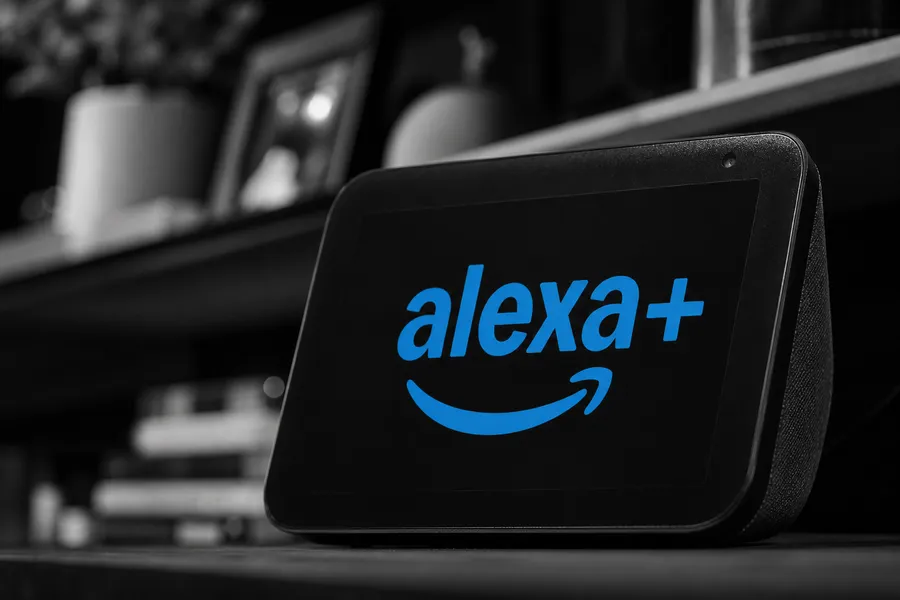
Amazon (AMZN) is designing its own AI chips for Echo, Fire TV and future consumer devices, a move that could deepen hardware-software integration and reduce dependence on third-party silicon vendors.
For investors, the shift signals Amazon’s intent to control a fuller slice of its consumer-hardware value chain – a strategy that could widen margins on devices while compounding the competitive moat around its Alexa ecosystem.
Key Takeaways
- Amazon is building end-to-end custom AI chips for consumer devices.
- On-device AI processing could cut cloud inference costs significantly.
- Move mirrors Apple’s silicon strategy, intensifying competitive pressure.
Market Reaction & Context
Amazon hardware chief Panos Panay confirmed the silicon initiative in an interview with CNBC, saying the company is designing chips “end-to-end” for select consumer products 1. AMZN shares have broadly tracked the Nasdaq Composite’s gains in 2026, buoyed by strong AWS revenue and investor enthusiasm for the company’s sprawling AI investments.
The custom-chip push mirrors the playbook executed by Apple (AAPL) with its M-series and A-series processors, which gave that company significant performance-per-watt advantages over rivals using off-the-shelf silicon. Amazon’s move is notable because it extends a chip-design capability – already mature in its AWS cloud business through the Trainium and Graviton lines – into the mass-market consumer device segment, where unit volumes are far higher and cost sensitivity is acute.
Amazon’s broader AI chip ambitions also extend well beyond consumer gadgets. Separately, the company’s AI chief Peter DeSantis said in June that commercially useful quantum computers could arrive within five to seven years, positioning Amazon as a full-stack technology developer from consumer endpoints to cutting-edge compute 2. That ambition has not gone unchallenged internally – Amazon’s own workforce has raised concerns about the pace and governance of the company’s AI expansion.
Detailed Analysis
Custom silicon for consumer devices carries two distinct financial implications. First, on-device inference reduces the volume of API calls routed to AWS data centres, lowering per-unit operating costs over the lifetime of each device. Second, tighter hardware-software co-design typically enables features that rivals running generic chips cannot replicate quickly, creating a stickiness advantage in the smart-home and streaming markets.
Amazon already sells tens of millions of Echo and Fire TV units annually, meaning even modest improvements in chip efficiency could translate into meaningful aggregate cost savings. Analysts have pointed to Apple’s silicon transition as a template: that shift took roughly three years to complete but produced sustained gross-margin expansion in the Mac and iPad segments.
The competitive landscape is crowded. Google (GOOG) integrates its own Tensor chips into Pixel devices and Nest speakers, while Apple’s HomeKit ecosystem runs on tightly controlled proprietary silicon. A purpose-built Amazon AI chip could allow Alexa to handle more complex on-device inference – voice recognition, contextual reasoning, personalisation – without a round-trip to the cloud, which also improves response latency for end users.
Management Perspective
“We’re designing end-to-end silicon for some of our consumer devices,” Panay told CNBC, adding that the goal is to better connect hardware and software while enabling richer AI features on-device.
That framing is consistent with Amazon’s broader posture on vertical integration. CEO Andy Jassy has argued publicly that custom chips represent a structural edge in the AI era, citing the company’s Trainium and Inferentia lines as evidence that in-house silicon can outperform merchant alternatives on cost and performance curves 3.
Conclusion
Amazon’s consumer-chip initiative is an incremental but strategically significant step in its vertical integration story. If successful, it could shrink per-device operating costs, strengthen Alexa’s feature lead over rivals and give AMZN a durable hardware advantage that third-party silicon vendors cannot easily replicate. Investors focused on Amazon’s long-term margin trajectory and its competitive positioning in smart-home and streaming hardware will want to watch for product-launch disclosures that reveal which devices carry the first generation of proprietary silicon.
Not investment advice. For informational purposes only.
References
1Arjun Kharpal (Jun 17, 2026). “Amazon AI exec predicts first ‘commercially useful’ quantum computers in 5-7 years”. CNBC. Retrieved July 2, 2026.
2Arjun Kharpal (Jun 17, 2026). “Amazon AI exec predicts first ‘commercially useful’ quantum computers in 5-7 years”. CNBC. Retrieved July 2, 2026.
3(“Amazon CEO explains how the company will compete against Microsoft, Google in AI race” Jul 7, 2023). CNBC International via Facebook. Retrieved July 2, 2026.