
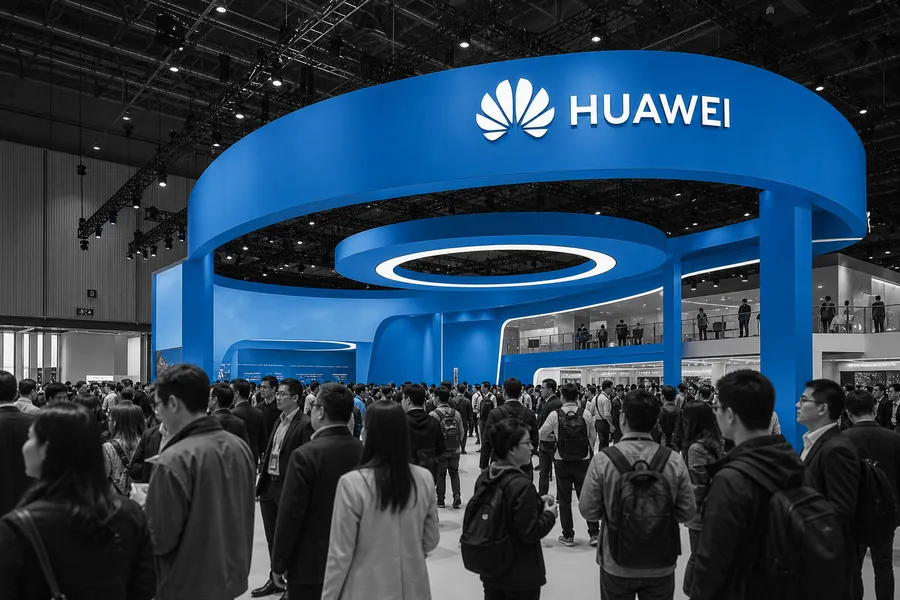
HP Inc. (HPQ) signed a multi-year global WiFi patent licensing agreement with blacklisted Chinese telecoms giant Huawei on Wednesday, a deal that underscores how standard-essential patents can bridge even the most fraught geopolitical divides.
For investors watching HP ahead of its third-quarter fiscal 2026 earnings release – scheduled for Thursday morning Beijing time – the agreement raises questions about regulatory exposure and the extent to which U.S. restrictions on Huawei can govern intellectual-property flows rather than hardware supply chains.
Key Takeaways
- HP licenses Huawei WiFi patents in a multi-year global deal.
- Deal stems from a resolved patent dispute via the Sisvel WiFi 6 pool.
- HP calls it routine; insists no broader Huawei strategic relationship exists.
Market Reaction & Context
No immediate share-price move was attributed specifically to the licensing announcement, with HPQ trading broadly in line with the Philadelphia Semiconductor Index in Tuesday’s session. The timing nonetheless draws scrutiny: HP reports earnings less than 24 hours after the deal’s disclosure, meaning analysts will likely press management on compliance costs and any royalty obligations on the call.
Huawei has aggressively monetised its patent portfolio since U.S. export restrictions cut off its access to American chips and software beginning in 2019 1. Licensing revenue from standard-essential patents – which cover technologies required to implement industry standards such as WiFi – has become a growing revenue line for the Chinese firm as hardware sales stagnated.
Deal Structure & Background
The agreement covers certain WiFi patents held by Huawei and includes reciprocal rights from HP’s own patent portfolio, according to Steven Geiszler, who represented Huawei in the negotiations 1. Geiszler, a former senior in-house intellectual-property lawyer at Huawei for nearly a decade, set up his own firm in April with Huawei as his primary client.
The deal is an outgrowth of a broader patent dispute resolved late last year, when HP joined the Sisvel WiFi 6 patent pool – a consortium of roughly 2,000 patents related to wireless network connectivity of which Huawei was a founding member in 2022 1. Sisvel pools are a common mechanism for distributing standard-essential patent royalties across the industry.
Regulatory Calculus
Huawei has been on the U.S. Commerce Department’s Entity List since 2019, barring American companies from supplying it with goods, software, and technology without a licence 1. Licensing inbound intellectual property from a blacklisted entity occupies a different legal lane than outbound supply, though the optics remain sensitive in Washington’s current trade climate.
HP moved quickly to frame the arrangement as unremarkable. “This is a standard-essential patent license covering Wi-Fi technology – something used broadly across the industry and routine for companies whose products connect to Wi-Fi. It is not new, does not represent a broader strategic or commercial relationship, partnership, or collaboration with Huawei,” the company said in a statement 1.
Outlook
Whether regulators accept that framing may depend on what emerges during the earnings call Thursday and any subsequent Commerce Department review. Standard-essential patent licences between U.S. and Chinese entities have precedent – multiple smartphone makers have struck similar deals with Huawei – but the political sensitivity of any Huawei tie, however narrow, has increased as U.S.-China technology tensions persist.
Investors will also want clarity on whether the cross-licence grants Huawei any meaningful access to HP’s own patent estate, and whether that could attract additional regulatory scrutiny. For now, HP has characterised the arrangement as a cost of doing business in a WiFi-connected world rather than a strategic pivot.
Conclusion
The HP-Huawei WiFi licensing accord illustrates the growing complexity that standard-essential patents introduce into U.S. tech-trade policy: companies whose products depend on globally standardised wireless protocols may find it commercially unavoidable to engage with IP held by entities their government has restricted. How HP navigates the regulatory and reputational dimensions of that tension could influence how peers approach similar situations.
Not investment advice. For informational purposes only.
References
1Evelyn Cheng (2026-08-25). “HP partners with U.S.-blacklisted Huawei for licensing the Chinese company’s WiFi tech”. CNBC. Retrieved 2026-08-26.