
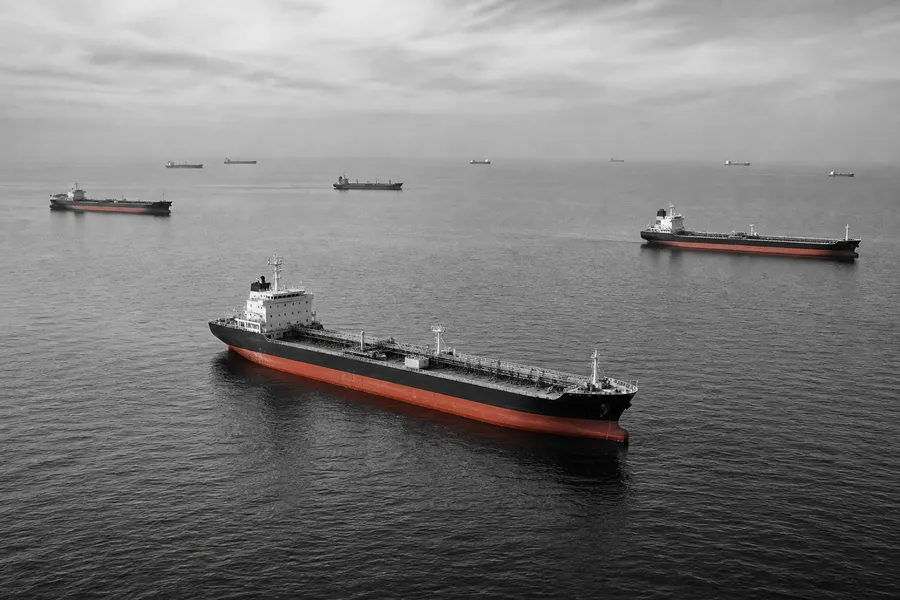
Iran’s Persian Gulf Strait Authority flatly rejected U.S. claims of dominance over the Strait of Hormuz on Wednesday, as vessel transit data showed traffic has plunged roughly 90% from pre-war levels, deepening the supply shock for energy markets globally.
With peace talks stalled and both sides hardening their positions, investors exposed to tanker operators, oil majors, and regional energy infrastructure face an indefinite disruption to one of the world’s most critical chokepoints – a waterway that historically handled roughly a fifth of global oil flows.
Key Takeaways
- Hormuz daily ship traffic near 3-month lows at ~13 vessels.
- Iran rejects U.S. control claims; demands sanctions relief and reparations.
- Peace talks remain stalled; Houthis open new front at Bab al-Mandab.
Market Context: A 90% Traffic Collapse
Ship transits through the Strait of Hormuz averaged roughly 13 vessels per day on a five-day rolling basis as of Tuesday – near the lowest level since May 12, according to trade intelligence firm Kpler data analyzed by CNBC 1. That compares with a pre-conflict daily average of 130 ships before the U.S. and Israel launched strikes on Iran on Feb. 28, representing a collapse of approximately 90%.
Al Jazeera separately reported that just eight vessels crossed the strait on Tuesday, citing Reuters, underscoring the severity of the disruption 2. For context, oil prices have already swung sharply on prior signals of easing tensions, illustrating how sensitive energy markets remain to any shift in Hormuz status.
Dueling Narratives From Washington and Tehran
President Donald Trump said on Truth Social that “The U.S.A. has total control over the Strait of Hormuz. I THINK WE WILL KEEP IT!” – his second such claim in as many days 1. Iran’s Persian Gulf Strait Authority pushed back directly, saying in a post on X that “Claims and repeated posts by U.S. officials that the Strait of Hormuz is no longer blocked do not change the reality: the Strait of Hormuz remains blocked and will not be reopened until Iran’s conditions are accepted.” 1
Independent analysts sided with Tehran’s assessment of the physical situation. Dennis Citrinowicz, a senior researcher at the Institute for National Security Studies, said on X: “The United States does not control the Strait of Hormuz. Despite everything that has happened, Iran retains sufficient capabilities to disrupt maritime traffic through the strait.” 2
Stalled Diplomacy and Expanding Conflict
Negotiations between Washington and Tehran have effectively frozen, with both sides now demanding reparations from each other – a significant escalation in rhetorical terms 1. Iran’s Supreme National Security Council laid out sweeping conditions for reopening the strait over the weekend, including a full end to the U.S. naval blockade, comprehensive sanctions relief, American troop withdrawals, and war reparations 1.
A Memorandum of Understanding reached in June dissolved in mid-July, and sporadic military incidents have continued, including a U.S. Navy helicopter striking a Panama-flagged cargo vessel on Tuesday 2. Meanwhile, Yemen-based Houthi forces opened an additional front, killing six people in an attack on an Egyptian-owned ship in the Bab al-Mandab Strait – a second key regional chokepoint 2.
Iran’s Strategic Calculus
Mohammad Reza Naqdi, a senior advisor to Iran’s Islamic Revolutionary Guard Corps commander, said in a PBS interview Tuesday that “victory is on our side” and characterized U.S. military performance as weaker than Iran had anticipated 1. He described Washington’s shifting objectives – from threatening Kharg Island to seeking full Hormuz control – as evidence of strategic incoherence, saying: “We saw confusion and bewilderment in America. It became a war without a strategy. Every two or three days, they announced a new objective.” 1
When asked whether Iran’s plan was to drag the conflict past the U.S. midterm elections in November, Naqdi said the goal was to “attain deterrence” – and that prolonging the conflict to impose costs on any future attacker was one viable path to that objective 1. Pakistan’s government said Wednesday it was actively working to bring the two sides back to the negotiating table, with Deputy Prime Minister-level contacts made on Aug. 10 with officials from Iran, Saudi Arabia, and Kuwait 2.
Outlook
Energy Secretary Chris Wright said Tuesday that the seven-day average for oil leaving the strait had recovered to nearly 9 million barrels per day, a figure that independent analyst Brett Erickson of Obsidian Risk Advisors called unsupported, saying there was “zero evidence that 9Mbpd is exiting the Strait of Hormuz per day” 2. Crude prices have shown sensitivity to each development in the conflict, and any credible resolution signal would likely trigger an immediate market repricing.
With both the diplomatic track and the military situation in flux, the strait’s near-term status hinges on whether Iran-Oman talks – from which Washington is excluded – can produce a framework that Tehran finds acceptable 2. Until then, the data suggests that claims of normalisation, from either side, should be treated with caution.
Not investment advice. For informational purposes only.
References
1Spencer Kimball and Deena Zaidi (2026-08-13). “‘Hormuz remains blocked’: Iran disputes Trump claims as traffic sinks to near 3-month lows”. CNBC. Retrieved 2026-08-13.
2Al Jazeera Staff (2026-08-12). “As Strait of Hormuz transit drops, Trump again says US has ‘control'”. Al Jazeera. Retrieved 2026-08-13.