
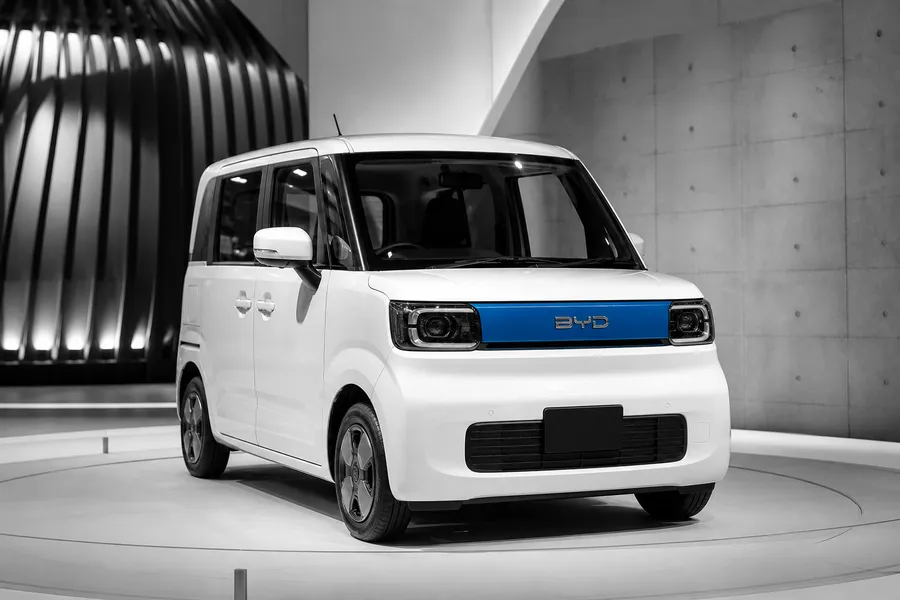
China’s BYD Co. launched the Racco electric kei car in Japan on Tuesday, its fifth model in the market and a direct price challenge to domestic brands that control roughly 40% of annual new-vehicle sales.
The move matters to investors because kei cars-Japan’s uniquely compact vehicle class-represent the single largest EV sub-segment in the country, and a credible Chinese entrant could compress margins at Nissan, Honda, Suzuki, and Subaru, all of which lean heavily on the category for domestic volume. 1
Key Takeaways
- Racco priced around ¥2.6 million (~$17,000), matching Nissan Sakura entry level.
- Kei cars account for ~40% of Japan’s new-vehicle sales annually.
- BYD sold just 2,223 EVs in Japan in 2024, a 4% share of electric sales.
Competitive Positioning & Market Context
Japan’s kei-car EV segment is currently dominated by two domestic nameplates: the Nissan Sakura and Mitsubishi eK X, which together represented more than 40% of all electric-car sales in Japan in 2024. 3 BYD’s total Japanese passenger-car sales that year stood at 2,223 units-a sliver of the roughly 1.55 million kei cars sold annually-underscoring how steep the climb remains for the Shenzhen-based automaker. 3
The Racco carries a starting price of approximately ¥2.6 million ($17,000), almost identical to the Nissan Sakura’s ¥2.59 million entry point, suggesting BYD is targeting parity rather than a steep discount to win early adopters. 3 By contrast, BYD’s broader global push has made it the world’s leading EV seller by volume, armed with proprietary Blade battery technology that also supplies Tesla, Toyota, and Mercedes-Benz-a cost structure analysts say few rivals can replicate at this price point. 3
Japan’s auto sector faces mounting pressure on multiple fronts; Volkswagen has already downgraded its 2026 sales outlook amid a China slump, illustrating how Chinese EV momentum is reshaping competitive dynamics across legacy automaker portfolios globally.
Why Japan Has Been a Hard Market
Since entering Japan’s passenger-car segment in 2023 with the Atto 3 SUV, BYD has added the Dolphin, Seal, and Sealion 7, yet cumulative traction has been limited. Japan’s market remains unusually resistant to foreign brands, shaped by deep domestic loyalty, a dense dealer network built around homegrown names, and a preference for gasoline-electric hybrids over pure battery vehicles. 1
The kei-car category adds a further structural hurdle: Japanese regulations define the class by strict dimensional limits-no longer than 3,400 mm, no wider than 1,480 mm-that BYD had to engineer to from scratch, given that even its smallest existing model, the Seagull, measures 3,780 mm in length. 3 The Racco represents the company’s first purpose-built entry for this regulatory envelope. 1
Industry Reaction
Japanese dealers have not disguised their concern.
“Young people do not have a negative view of BYD. It would be a huge threat if the company launches cheap models in Japan,”
a Suzuki dealer said, as cited by Nikkei Asia. 3 That sentiment resonates across a dealer network that has relied on kei-car volumes to offset softness in larger segments.
BYD has been recruiting staff with “extensive experience” in Japan’s light-vehicle business, signalling a long-term infrastructure commitment rather than a one-model trial. 3 Whether that investment translates into material share gains will depend on after-sales service density-historically the weakest link for foreign entrants in Japan.
Outlook
The Racco’s commercial debut is the most tangible test yet of whether BYD’s battery-cost advantage can overcome Japan’s formidable brand loyalty. Analysts note the pricing parity strategy is logical: matching, not undercutting, the Sakura avoids triggering an immediate price war while allowing BYD to compete on technology perception. 1
A sustained sales ramp would have read-across implications for Honda (7267.T), Nissan (7201.T), and Suzuki (7269.T), whose domestic earnings depend disproportionately on kei-car margins. For now, BYD’s Japan footprint remains too small to move those needles, but the Racco launch marks the first time the competitive threat has arrived at precisely the segment those companies can least afford to cede. 12
Not investment advice. For informational purposes only.
References
1(Oct 29, 2025). “BYD set to launch first electric mini kei car in Japan”. Automotive News. Retrieved July 27, 2026.
2(Oct 29, 2025). “BYD Reveal Cheap Kei Car – The Brands Cheapest EV EVER”. The Electric Viking via YouTube. Retrieved July 27, 2026.
3Peter Johnson (May 7, 2025). “BYD’s new mini EV is ‘a huge threat’ to Japanese automakers and it’s coming soon”. Electrek. Retrieved July 27, 2026.
4(Oct 28, 2025). “BYD’s mini-car ambitions may be a wake-up call for Japan”. Reuters via Facebook. Retrieved July 27, 2026.