
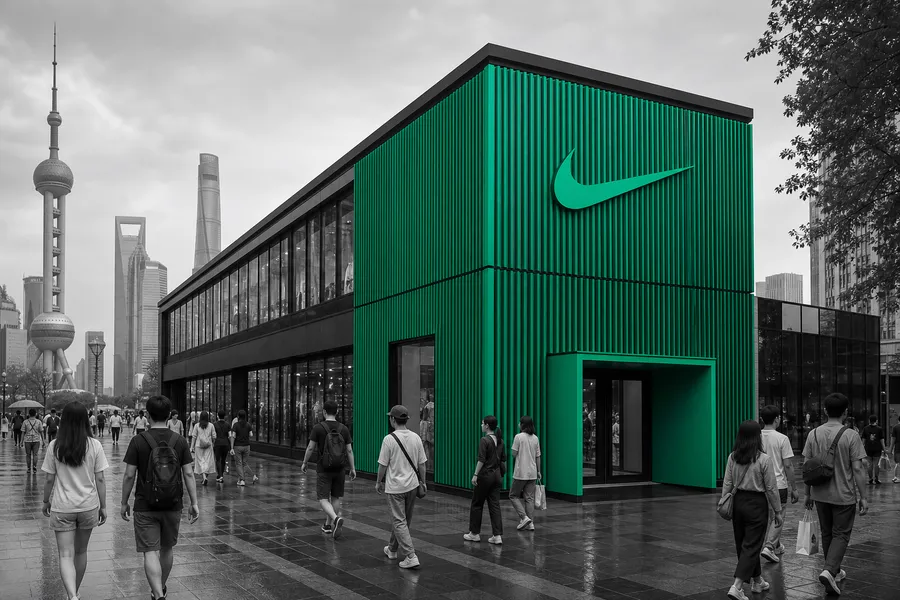
Nike (NKE) said Tuesday it will cut off thousands of online distributors in China starting January 2027, consolidating digital sales into a handful of official storefronts in a bid to stabilize pricing and reverse a roughly 30% revenue decline in the region over five years.
The move carries material near-term earnings risk for Nike and its largest mainland distributor, Topsports, while drawing immediate comparisons to a prior wholesale pullback in North America that contributed to a significant erosion of market share.
Key Takeaways
- Nike to funnel China online sales to Tmall, JD.com, Douyin, and owned channels.
- Greater China Q4 sales fell 17% on a constant-currency basis.
- BNP Paribas maintains underperform, warns of repeat North America misstep.
Distribution Reset in Context
Nike’s Greater China segment recorded a 17% constant-currency revenue decline in its fiscal fourth quarter, accelerating from a 10% drop in the prior period – a trajectory that compares unfavorably with domestic rivals Anta and Li Ning, both of which have posted positive comparable sales growth in the same window 1. Foreign upstarts On Running and Hoka have simultaneously carved out share in performance and lifestyle categories, tightening the competitive squeeze on the Oregon-based brand.
Under the restructured model, most of Nike’s 16 store partners in mainland China will lose the right to sell Nike products through digital channels 2. Sales will instead flow exclusively through Nike’s own website and app, plus official brand flagships on Tmall, JD.com, and Douyin – China’s dominant short-video commerce platform.
Detailed Analysis
The fragmentation problem Nike describes is real: thousands of third-party online storefronts operated by brick-and-mortar partners have created divergent pricing and inconsistent brand presentation, undermining full-price sell-through and consumer trust. Cathy Sparks, Nike’s vice president and general manager of Greater China, said the marketplace had become “so fragmented and cluttered,” adding that consumers want “an experience that’s premium, true to the brand, trustworthy, and certainly connected between digital and physical” 2.
Topsports – Nike’s largest mainland distributor for 27 years – disclosed in a Hong Kong exchange filing that its board anticipates a “significant” short-term negative impact; online Nike product sales represent 22% of Topsports’ total revenue 2. Despite the financial hit, CEO Yu Wu publicly endorsed the strategy, saying the company “firmly believes that, over the medium- to long-term, this direction will help promote a healthier, more orderly, and more sustainable retail ecosystem in China” 1.
The structural parallel investors are watching most closely is Nike’s earlier decision to slash North American wholesalers, a move that freed up shelf space for competitors and contributed to a collapse in the brand’s domestic market dominance 1. BNP Paribas equity analyst Laurent Vasilescu drew that comparison explicitly, writing that Nike has “a product problem, not a distributor problem” and reiterating an underperform rating on the stock 3.
CEO Elliott Hill, who took the helm nearly two years ago, has made China e-commerce restructuring one pillar of a broader turnaround that also includes sports-focused product repositioning and a new vice president of local product creation for Greater China – an acknowledgment that brand relevance, not just channel architecture, needs fixing. As China’s tech and consumer policy environment evolves, Nike’s channel strategy intersects with the broader push by Beijing to advance domestic digital ecosystems, which could shape how foreign brands negotiate platform terms on Tmall and Douyin going forward.
Outlook and Management Quote
Sparks framed the January shift as a brand-strengthening exercise rather than a retrenchment. “These new flagships will serve as the single, elevated destination for Nike within these ecosystems, with clearer product presentation, stronger storytelling and more connected consumer journeys,” she said in a letter to partners 1.
Nike’s own guidance acknowledges that the channel consolidation could produce a near-term revenue decline in Greater China before any recovery materializes – a concession that raises the stakes for the company’s fiscal 2027 results in the region 1.
Conclusion
For investors, Nike’s China e-commerce overhaul is a high-conviction but high-risk wager: if Chinese consumers follow Nike to its curated storefronts, the brand gains pricing power and margin recovery; if they defect to Anta, Li Ning, or foreign alternatives already occupying the vacated digital shelf space, the revenue erosion could accelerate well beyond current consensus estimates. The North America analogy is instructive but imperfect – execution and local product relevance will ultimately determine whether this reset marks an inflection point or deepens the decline.
Not investment advice. For informational purposes only.
References
1Fonrouge, Gabrielle (2026-07-21). “Nike to cut off thousands of online distributors in China, restructure digital footprint”. CNBC. Retrieved 2026-07-22.
2(2026-07-22). “Nike to Shut Down Thousands of Online Distributors in China in Bid to Revive Brand”. BigGo Finance. Retrieved 2026-07-22.
3Young, Vicki M. (2026-06-24). “Nike Could Be Shaking Up Its China Business: Here’s How”. WWD / Footwear News. Retrieved 2026-07-22.
4Kaye, Danielle (2026-07-21). “Nike to tighten online sales in China amid ‘cluttered’ marketplace”. Reuters via MSN. Retrieved 2026-07-22.