
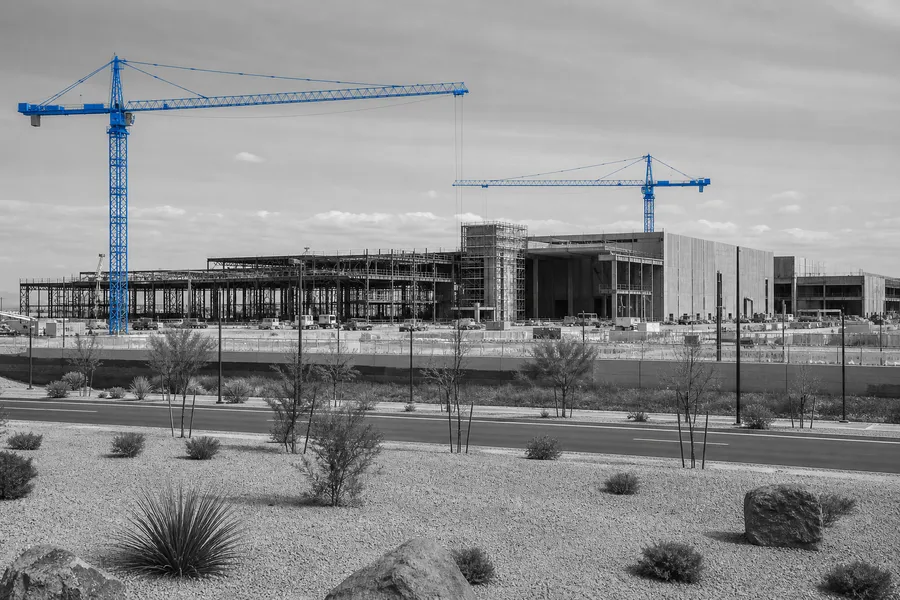
Taiwan Semiconductor Manufacturing (TSM) pledged an additional $100 billion for its Arizona complex on Thursday, lifting its total U.S. commitment to $265 billion as AI-driven chip demand outpaces the foundry’s current capacity.
For investors tracking semiconductor supply chains, the scale-up signals both a structural shift in where advanced chips are made and a potential multi-year revenue tailwind that rivals Samsung and Intel have yet to match on U.S. soil.
Key Takeaways
- Total U.S. investment reaches $265 billion across six planned Arizona fabs.
- Q2 net income surged 77% year-on-year to $22 billion.
- 2-nanometer and advanced packaging capacity being fast-tracked.
Earnings Firepower Behind the Expansion
TSMC reported second-quarter net income of NT$706.6 billion ($22 billion), a 77% year-on-year jump that exceeded analyst consensus estimates of NT$623.7 billion 1. Quarterly revenue reached NT$1.27 trillion, up 36% from a year earlier, giving management the financial headroom to accelerate capital spending to between $60 billion and $64 billion for the full year – up from a prior forecast of $56 billion.
High-performance computing, the segment most exposed to AI workloads, accounted for 58% of TSMC’s 2025 net revenue, up sharply from 51% in 2024, while smartphones slipped to 29% from 35% 2. That mix shift underscores why the company is front-loading capacity in its most advanced nodes rather than waiting for consumer electronics demand to recover.
For context on competitive positioning, TSMC’s record profits reflect an AI chip boom that has left peers scrambling to close a technology gap that analysts estimate spans at least one full process generation.
The Arizona Build-Out in Detail
The $100 billion incremental pledge – announced at Thursday’s earnings conference – covers 2-nanometer and sub-2-nanometer technologies, plus advanced packaging fabs to serve leading U.S. customers 1. It comes on top of the $165 billion commitment made in March 2025, which itself included plans for six advanced wafer fabs, two packaging facilities and a research-and-development centre in Phoenix 2.
Construction of the second Arizona fab is complete, with tool installation and ramp planned for later in 2026; high-volume manufacturing is now targeted for the second half of 2027, a schedule TSMC said it is actively trying to pull forward 2. Work on the third fab has begun, permits for a fourth are being sought, and TSMC has purchased a second large land parcel near the site to preserve optionality for further expansion.
Management Rationale and Direct Quotes
Chairman and CEO C.C. Wei framed the decision in blunt capacity terms.
“We are going to expand many fabs over there and this gigafab cluster can help us to improve the productivity, to lower down the cost and to serve our customers in the U.S. better,”
Wei said on the earnings call 2. He added that capacity remains “very tight” and that cloud service providers are approaching TSMC directly to secure allocations.
CFO Jen-Chau Huang, speaking separately to CNBC, pointed to conviction on the structural demand story.
“We have strong conviction on the AI mega trend, and that is the reason we are stepping up the capital expenditures to expand in Taiwan and in the U.S.,”
Huang said 3. TSMC guided Q1 2026 revenue of $34.6 billion to $35.8 billion and projected full-year 2026 revenue growth of nearly 30% 2.
Geopolitical and Trade Context
The expansion is partly a hedge against tariff risk. The Trump administration imposed a 100% tariff threat on foreign-made semiconductors last August before lowering duties on Taiwan imports to 15% under a bilateral trade deal struck in January 2026 1. Companies that actively commit to U.S. manufacturing were explicitly exempted from the harshest measures, making TSMC’s accelerated buildout a strategic as much as a commercial decision.
A $250 billion U.S.-Taiwan trade framework, reported by the Wall Street Journal in January, provides additional policy scaffolding for the expansion and aims to reshore the domestic semiconductor sector more broadly 2. TSMC is also accelerating a new wafer fab in Japan’s Kumamoto prefecture, deploying 3-nanometer technology there as a further geographic hedge 1.
Investor Implications
The combination of record earnings, a 30% revenue growth forecast and a $265 billion capital commitment concentrated in the highest-margin process nodes positions TSMC as the primary infrastructure play on global AI compute buildout. The risk to that thesis is whether capital expenditure growth, now running at roughly 15% above prior guidance, compresses near-term free cash flow margins.
Wei acknowledged the demand-supply gap is real but said the Arizona gigafab cluster is specifically designed to close it efficiently by clustering fabs to drive productivity gains and cost reductions at scale 2.
Not investment advice. For informational purposes only.
References
1Iris Deng (Jul 16, 2026). “TSMC pledges extra US$100b for Arizona fab expansion amid soaring AI chip demand”. South China Morning Post. Retrieved July 19, 2026.
2Sara Samora (Jan 16, 2026). “TSMC ramps up Arizona production as AI demand drove 2025 revenue to $122B”. Manufacturing Dive. Retrieved July 19, 2026.
3Dylan Butts, Emily Tan (Jan 16, 2026). “TSMC is set to expand its $165 billion U.S. investment – here’s what we know”. CNBC. Retrieved July 19, 2026.
4Alice Chambers (Apr 13, 2026). “TSMC Accelerates Arizona Expansion as AI Demand Surges”. Technology Magazine. Retrieved July 19, 2026.
5Amy Edelen/Phoenix Business Journal (Jul 18, 2025). “TSMC to accelerate production at Arizona fabs amid surging AI demand”. KTAR News. Retrieved July 19, 2026.