
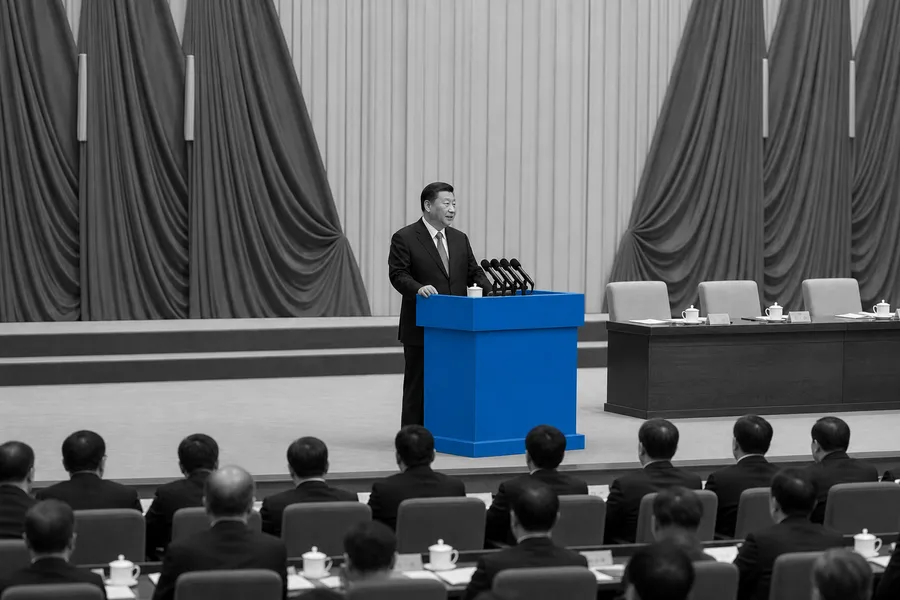
Chinese President Xi Jinping will address the World Artificial Intelligence Conference in Shanghai on Friday for the first time, as Huawei unveils a sanctions-circumventing AI computing cluster that challenges Nvidia’s (NVDA.O) dominance in high-performance AI hardware.
For macro investors, the dual signal – top-level political commitment combined with a tangible hardware breakthrough – sharpens the competitive threat to U.S. semiconductor and cloud-infrastructure names while raising the stakes in the first government-level U.S.-China AI talks under President Donald Trump’s administration.1
Key Takeaways
- Xi attends WAIC for first time, framing AI as strategic national priority.
- Huawei’s Atlas 950 SuperPoD debuts as Nvidia-free AI training cluster.
- U.S.-China government AI talks imminent; governance rivalry intensifies.
Hardware Context: A Direct Challenge to Nvidia
Huawei’s Atlas 950 SuperPoD – set for its public debut at the July 17-20 Shanghai forum – links thousands of Ascend AI processors through high-speed interconnects to operate as a single large-scale computing cluster.1 The system is designed explicitly for the AI training and inference workloads where Nvidia’s H100 and B200 chips currently dominate, making it the clearest demonstration yet that Beijing can field competitive infrastructure without U.S. export-controlled silicon.
DeepSeek’s latest V4 model has already been adapted to run entirely on Huawei Ascend-based clusters, validating the ecosystem beyond a single showcase.1 Chinese chipmakers Biren and MetaX are also expected to release new “supernode” computing clusters at the conference, broadening the domestic supply chain. The parallel developments suggest investors in U.S. semiconductor equipment and chip designers may face a more durable demand headwind from China than previously modelled – a dynamic also visible in Tesla’s (TSLA) experience navigating China’s fast-moving technology competitive landscape.
Geopolitical Stage: Governance as Diplomacy
Xi’s first-ever attendance at WAIC transforms what has historically been a product showcase into a high-stakes geopolitical event.2 The conference runs alongside a High-Level Meeting on Global AI Governance in Shanghai, where progress on China’s proposed World AI Cooperation Organisation (WAICO) and implementation of Beijing’s Global AI Governance Initiative are expected to be announced.
The timing is pointed: Washington and Beijing are preparing their first government-level AI dialogue under the Trump administration, and the two rivals staked out opposing positions at a UN AI session last week. Washington argued that heavy regulation stifles innovation; Beijing positioned its low-cost, open-source models as a public good that narrows the global AI gap.1
“Against this backdrop, WAIC has become more than a technology showcase; it is now a geopolitical stage where Beijing seeks to articulate its vision of AI as both a national priority and a diplomatic instrument,” said George Chen, chair of digital practice at the Asia Group.1
Absent from the attendee list are major U.S. technology firms, a notable contrast to the roster of international leaders – UN Secretary-General Antonio Guterres, Kazakh President Kassym-Jomart Tokayev and Thai Prime Minister Anutin Charnvirakul – as well as nine Turing Award and Nobel laureates including deep learning pioneers Yoshua Bengio and Richard Sutton.1
Open-Source Push and Emerging-Market Inroads
Beijing is expected to aggressively promote open-source AI models as a low-cost alternative to proprietary Western offerings, particularly targeting the Global South. “China has been making inroads with Southeast Asian countries in terms of AI capacity-building, and portrays itself as speaking up for developing countries who are being left behind in the AI race,” an Asian diplomat told Reuters on condition of anonymity.1
A People’s Daily commentary this week framed the argument in stark terms: “The development of AI must never move toward a technological monopoly that walls itself in, but should always be anchored to the fundamental goal of serving humanity.”1 For sector investors, the open-source offensive could compress pricing power for Western AI-platform companies if Beijing successfully recruits emerging-market governments as anchor users of Chinese models and infrastructure – a pattern worth watching alongside U.S. industrial policy efforts such as domestic chip supply-chain partnerships.
Outlook
Xi has previously compared AI to the steam engine in its transformative scope, and Beijing has formally committed to AI-led economic growth alongside technology self-sufficiency as twin policy pillars.1 With WAICO still seeking formal members a year after it was first proposed, the governance initiative’s traction will be an early read on China’s soft-power reach in the AI era.
The conference outcome – particularly any concrete WAICO memberships or U.S.-China AI talk framework – will be a near-term catalyst for Nvidia (NVDA.O) sentiment, Chinese AI-adjacent ADRs and any ETFs tracking semiconductor supply-chain exposure to the China market.
Not investment advice. For informational purposes only.
References
1Laurie Chen (2026-07-16). “China’s Xi to outline AI diplomacy vision at key Shanghai forum”. Reuters. Retrieved 2026-07-16.
2(2026-07-16). “China’s Xi to outline AI diplomacy vision at key Shanghai forum”. AOL / Reuters. Retrieved 2026-07-16.