
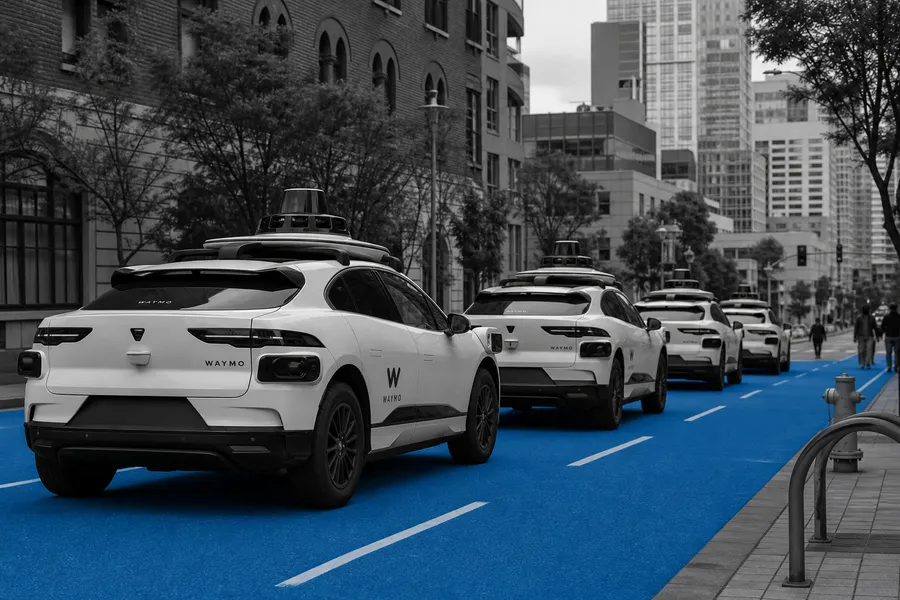
Alphabet’s (GOOGL) Waymo said Wednesday it will launch fully driverless rides in San Diego, Las Vegas, Tampa, and Denver, extending its commanding lead over rivals Tesla and Amazon-owned Zoox in the nascent U.S. robotaxi market.
The expansion pushes Waymo’s footprint beyond 10 operational U.S. cities, a scale advantage that analysts say makes it increasingly difficult for competitors to close the autonomous-miles gap that underpins both safety data and commercial credibility.
Key Takeaways
- Four new cities added; employee rides begin within weeks.
- Waymo now operates across more than 10 U.S. cities, 24/7.
- Hyundai IONIQ 5 fleet integration begins alongside the expansion.
Competitive Positioning & Market Context
Waymo’s network now spans more than 1,400 square miles across the United States, a figure that dwarfs the current operational footprint of domestic challengers 1. Amazon’s Zoox, which has been targeting its own public launch, has yet to match Waymo’s commercial scale in any single market, let alone across 14-plus cities simultaneously.
Tesla’s robotaxi ambitions remain largely in testing phases, leaving Waymo as the only U.S. operator with a statistically significant, publicly available safety dataset – a factor that carries regulatory and insurance-pricing weight as Washington debates AV oversight frameworks.
The Four-City Rollout: What Investors Need to Know
The new markets – San Diego, Las Vegas, Tampa, and Denver – represent a diverse mix of climates, traffic densities, and regulatory environments, a deliberate stress test for Waymo’s sixth-generation autonomous stack 2. Rides will first be offered to Alphabet employees, a phased approach Waymo has used in every prior market to calibrate operations before public launch.
The company said it expects to open public access “soon” after the employee phase, consistent with its Nashville playbook, where tens of thousands of riders were onboarded from an interest list before a full public opening in June 2026 3.
Safety Data as a Commercial Asset
Waymo’s latest safety analysis, covering more than 220 million fully autonomous miles through March 2026, showed its vehicles were involved in 94% fewer crashes causing serious or fatal injuries compared with human drivers in equivalent conditions 3. At its current pace of more than four million autonomous miles per week, the company said that translates to roughly one fewer serious-injury crash every eight days across its fleet.
Those metrics matter commercially: insurers, municipal governments, and ride-hailing partners such as Lyft increasingly use safety performance records as a condition for market access agreements.
Platform Diversification: The IONIQ 5 Factor
Alongside the geographic push, Waymo said it has begun operating its growing Hyundai IONIQ 5 fleet autonomously with a specialist present – the validation phase before rider-only deployment 3. Diversifying beyond the Jaguar I-PACE reduces single-vehicle-platform risk and signals that Waymo’s Driver software is architected to port across hardware, a capability that could support future OEM licensing revenue.
Management Outlook
“These cities will join a growing network of over 10 cities where anyone can simply download an app and hail a fully autonomous Waymo vehicle to go where they want, 24/7, across our sizable service areas,” Waymo said in its official blog post Wednesday.
The company added that public riders in the four new markets can download the Waymo app now to be notified when access opens, a demand-signal mechanism the company has used to sequence waitlist rollouts in prior cities 3.
Conclusion
For Alphabet investors, Wednesday’s announcement is less a single data point than a confirmation of cadence: Waymo is adding cities at a pace that compounds its autonomous-miles dataset, safety record, and brand recognition simultaneously. Whether that operational lead translates into a standalone valuation event – via IPO, licensing deals, or deepened Lyft integration – remains the central question for the robotaxi investment thesis heading into 2027.
Not investment advice. For informational purposes only.
References
1Elias, Jennifer (2026, July 8). “Waymo to start driverless rides in 4 more U.S. markets as expansion accelerates”. CNBC. Retrieved July 8, 2026.
2CNBC (@CNBC) (2026, July 8). “Waymo starts driverless rides in four more U.S. markets as expansion accelerates”. X (formerly Twitter). Retrieved July 8, 2026.
3Waymo Team (2026, July 8). “Waypoint – The official Waymo blog”. Waymo. Retrieved July 8, 2026.