
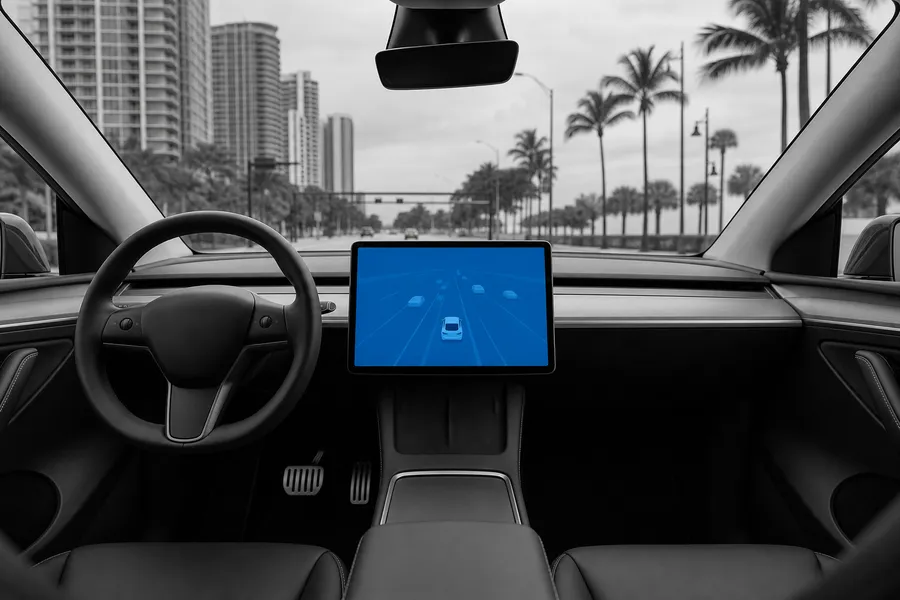
Tesla (TSLA) expanded its driverless robotaxi service to Miami on Friday, marking its second U.S. city deployment as shares slid 7.49% amid a broader tech sell-off, underscoring both the promise and investor unease around CEO Elon Musk’s pivot from electric vehicles to AI and robotics.
The Miami launch signals that Tesla is accelerating the commercial rollout of its Full Self-Driving software stack – a technology that management views as the company’s primary long-term earnings driver, distinct from its core vehicle business.
Key Takeaways
- Miami becomes Tesla’s second unsupervised robotaxi market after Austin.
- Waymo and Zoox are simultaneously scaling competing driverless services.
- Tesla posted record Q2 deliveries just one day before the Miami launch.
Market Reaction & Context
TSLA fell 7.49% on the session, underperforming the Nasdaq Composite, which itself dropped 0.80% as chip stocks weighed on the broader tech sector. 1 Alphabet (GOOGL), parent of rival Waymo, slipped 0.36%, while Amazon (AMZN), which owns autonomous-vehicle developer Zoox, edged up 0.40% – a divergence that illustrates how investors are still calibrating which platform-level robotaxi operator carries the most near-term execution risk.
The robotaxi sector is gaining critical mass simultaneously across multiple operators. Waymo has been steadily expanding its commercial driverless service in San Francisco, Los Angeles, and Phoenix, while Zoox continues development of its purpose-built autonomous shuttle. Tesla’s advantage, in management’s framing, is its ability to leverage a massive existing fleet of consumer vehicles already running FSD software.
The Miami Deployment: What Investors Need to Know
Tesla’s official robotaxi account said on X:
“Robotaxi now available in Miami.”
A social media post also confirmed the Miami service operates without a human safety monitor in the vehicle – a critical regulatory and commercial distinction. 2
Tesla first launched its unsupervised robotaxi service in Austin, Texas, in June, after disclosing in April plans to extend operations to Dallas and Houston. Miami represents the first market outside Texas, suggesting the geographic expansion cadence is quickening. Investors tracking Tesla’s progress toward regulatory clearance in international markets will note that U.S. city-by-city expansion also builds the data corpus and safety record regulators abroad typically require.
The timing is notable. On Thursday – one day before the Miami announcement – Tesla reported record second-quarter deliveries that beat Wall Street estimates, led by a rebound in European sales. 1 That combination of strong delivery numbers and an accelerating robotaxi footprint gives management a two-pillar narrative heading into Q2 earnings.
Competitive Positioning & Strategic Stakes
Musk said in May he expects fully self-driving vehicles without human safety monitors to become more widespread across the U.S. later this year – a projection that, if realised, would significantly alter the unit economics of ride-hailing. 1 For context, traditional ride-hailing platforms such as Uber and Lyft pay drivers roughly 70-75% of gross fares; eliminating that cost is the central bull case for autonomous ride-hailing margins.
Tesla’s FSD software, a version of which powers the robotaxis, is also sold as a subscription to retail vehicle owners – creating a dual revenue stream that pure-play robotaxi operators cannot replicate. Tesla’s manufacturing scale, already demonstrated in its Shanghai operations, provides additional cost leverage as it deploys purpose-built Cybercab vehicles alongside converted Model Y units. The company has not disclosed per-ride pricing or utilisation rates for its Austin or Miami operations.
Outlook
The expansion highlights Tesla’s efforts to increase adoption of its self-driving software as a key part of Musk’s strategic shift from EVs to AI and robotics, according to Reuters. 1 Analysts will be watching for any guidance on monetisation timelines, fleet size in each city, and safety incident disclosures when Tesla reports Q2 financial results – data points that will be central to valuing the robotaxi segment independently of the core automotive business.
Whether the Miami launch accelerates regulatory approvals in other states – or triggers closer scrutiny – remains the key near-term variable for institutional investors weighing TSLA’s robotaxi optionality against its still-significant EV execution risks.
Not investment advice. For informational purposes only.
References
1Das, Koyena (2026-07-03). “Tesla rolls out robotaxi service in Miami”. Reuters via Yahoo Finance. Retrieved 2026-07-03.
2Xu, Jianchun (2026-07-03). “Tesla Robotaxi now available in Miami!”. Facebook. Retrieved 2026-07-03.
3CNA / Channel News Asia (2026-07-03). “Tesla rolls out robotaxi service in Miami”. Threads/@channelnewsasia. Retrieved 2026-07-03.
4Tesla Investors Club (2026-07-03). “Tesla launches unsupervised robotaxi rides in [Miami]”. Reddit/r/teslainvestorsclub. Retrieved 2026-07-03.