
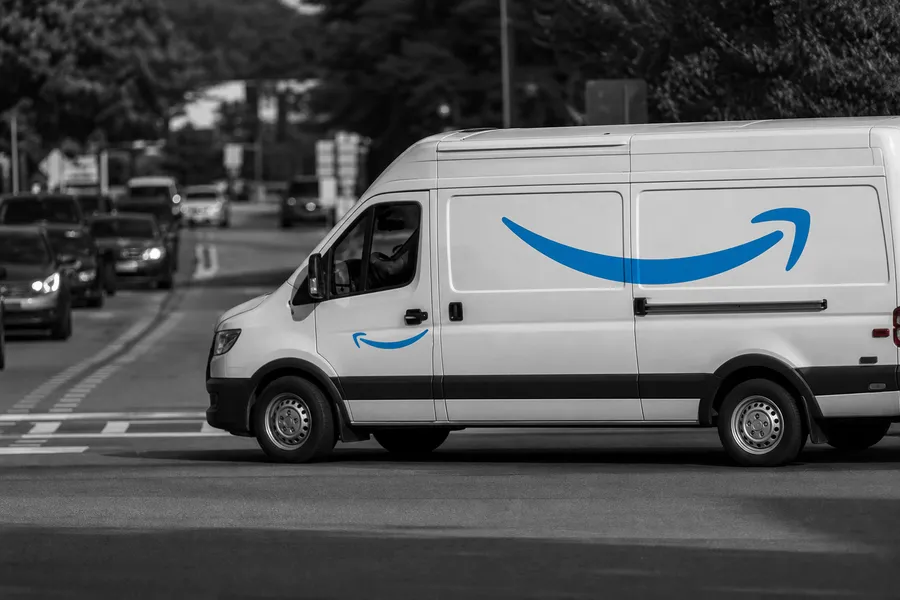
A formal complaint alleges Amazon (AMZN) retaliated against employees who testified at Seattle city hearings urging limits on data-center construction, adding a labor-risk dimension to the company’s $200 billion AI infrastructure push.
For investors tracking Amazon’s capital-expenditure trajectory, a sustained internal-dissent and regulatory backlash cycle could complicate permitting timelines and invite broader legislative scrutiny of hyperscaler spending across all 50 states.
Key Takeaways
- Seattle enacted a one-year moratorium on new data-center permits.
- Amazon employees filed a retaliation complaint after public testimony.
- Hyperscalers collectively plan $700 billion in AI infrastructure spending this year.
Market Reaction & Context
Amazon’s $200 billion capital-expenditure commitment for 2026 dwarfs peers on an absolute basis, though Microsoft (MSFT) is close behind at $190 billion; together the two companies account for more than half of the roughly $700 billion hyperscalers are expected to deploy on AI infrastructure this year alone. 1 A Gallup poll released this month found 70% of Americans oppose data-center construction in their local communities – a sentiment that has already triggered moratorium legislation in a dozen states and an outright ban in Monterey Park, California, where 86% of voters supported a permanent prohibition. 2
Regulatory friction at the municipal level has previously stalled individual projects; the broader question for AMZN shareholders is whether worker-driven complaints can accelerate that friction into a structural permitting headwind for AWS capacity expansion.
The Seattle Flashpoint
Three Amazon engineers – Liesl Wigand, Patrick Schloesser, and Darius Irani – testified at Seattle’s Land Use and Sustainability Committee on June 4, calling for tighter local oversight of data-center development. 3 All three are members of Amazon Employees for Climate Justice, an internal advocacy group that published an open letter in November 2025 demanding 100% locally sourced renewable power for all company data centers.
Schloesser, a six-year AWS software engineer, drew an explicit connection between capital allocation and workforce reductions. “Amazon is spending $200 billion on capital, with most of it going to data centers and AI,” he said at the hearing. “Meanwhile, the leaders at my company have laid off 30,000 corporate employees in the last eight months.” 1
Seattle City Council subsequently voted in favor of a one-year moratorium on new data-center permits, giving the city time to draft regulations for AI infrastructure projects. 2 Amazon said it has no current plans to build data centers within Seattle city limits.
Retaliation Allegation & Labor Risk
Following the public testimony, a formal complaint was filed alleging Amazon retaliated against the employees who spoke out, according to the headline report. Labor-law experts note that retaliation complaints tied to protected civic speech can trigger state and federal scrutiny, potentially expanding the legal surface area for a company already navigating antitrust and privacy probes.
Labor organizers described the Seattle action as the first time Big Tech employees have publicly and explicitly called for regulations governing data-center projects by name – a marker that, if replicated at other firms, could shift the locus of AI-infrastructure opposition from community groups to insider voices that carry more credibility with regulators. 3
Management Position & Broader Peer Landscape
Amazon spokesperson Margaret Callahan said the company is “committed to being a responsible neighbor – investing in local economic development while prioritizing water and energy efficiency that exceeds industry standards.” 3 She added that Amazon respects employees’ right to voice opinions and engages regularly with community stakeholders.
The environmental commitments offered by management – including a goal to be “water positive” by 2030 and current 53% progress toward that target – have not quieted critics inside or outside the company. 1 Oracle (ORCL), which disclosed $248 billion in future data-center lease obligations this spring while cutting an estimated 20,000-to-30,000 jobs, and Meta (META), which dismissed 10% of its workforce last month after doubling AI capex, face analogous tensions between infrastructure ambition and workforce optics.
Outlook
The Seattle moratorium vote – combined with the retaliation complaint – sets a template that activist employees and community coalitions in other AWS-heavy markets may seek to replicate. McKinsey projects total data-center investment could reach $7 trillion by 2030, meaning the regulatory and labor friction emerging in Seattle is a preview of a much larger governance debate. 2
Wigand’s warning to council members captured the stakes for the industry: “Let’s not let Big Tech burn Seattle to win the AI race.” 3
Not investment advice. For informational purposes only.
References
1Sasha Rogelberg (Jun 5, 2026). “‘Big Tech is desperate’: Amazon engineers are calling out the tech giant for its $200 billion in data center spending after slashing 30,000 workers”. Fortune. Retrieved June 18, 2026.
2Hayden Field (Jun 9, 2026). “Amazon employees ask Seattle to put the brakes on new data centers”. The Verge. Retrieved June 18, 2026.
3Paresh Dave (Jun 3, 2026). “Amazon Employees Show Up to City Council Meetings to Demand Limits on Data Centers”. WIRED. Retrieved June 18, 2026.