
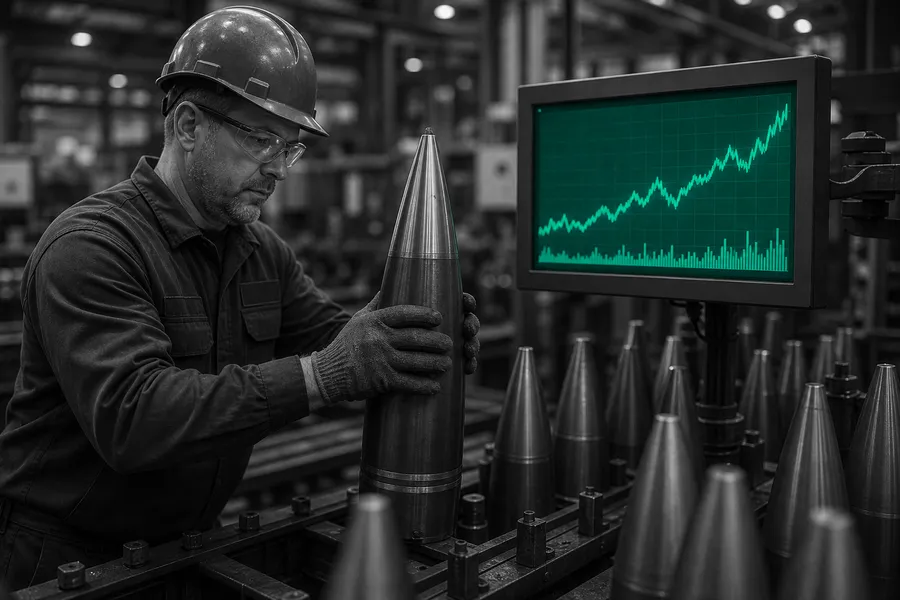
President Trump invoked the Defense Production Act on June 11 to address critical bottlenecks in U.S. munitions manufacturing and supply chains, a move that signals expanded federal authority over defense contractors and could accelerate order flows for weapons-system suppliers.
For investors in defense primes and their second- and third-tier suppliers, the directive unlocks government tools to fast-track voluntary agreements with private industry – a potential catalyst for contract volume in sectors already straining under wartime demand.1
Key Takeaways
- DPA invoked to fix capacity gaps in solid rocket motors and guidance systems.
- Pentagon secretary delegated authority to negotiate voluntary industry agreements.
- Action is the latest in a series of broad DPA deployments by the Trump administration.
Market Reaction & Context
The June 11 memorandum – made public Tuesday – arrives as Washington’s concern over weapons manufacturer capacity has intensified against the backdrop of the ongoing U.S.-Iran conflict, which began Feb. 28, 2026.2 Defense sector indices have broadly outperformed the S&P 500 since that date, with munitions and missile-component makers drawing particular investor attention amid rapid stockpile drawdowns.
The Trump administration has now invoked DPA authority multiple times in 2026, including five separate Section 303 determinations on April 20 targeting energy infrastructure ranging from petroleum refining to grid equipment – making the munitions memo the latest in an accelerating pattern of emergency industrial-policy actions.3
Detailed Analysis
The presidential memo identifies solid rocket motors, igniters, and guidance systems as among “the most critical and capacity-constrained sub-systems” for both legacy platforms and future modernization programs.1 Those components sit at the heart of precision-strike munitions demand that has surged since conflict with Iran disrupted Strait of Hormuz shipping and drew down U.S. offensive and defensive inventories.
Under Title VII of the Defense Production Act, the president – or those delegated the authority – may consult with industry representatives to establish voluntary agreements that help provide for national defense, but only after a formal finding that conditions pose a direct threat.2 Trump made that finding explicitly, writing in the June 11 memo to the Pentagon chief:
“I hereby find that conditions exist which may pose a direct threat to the national defense or its preparedness programs.”
He cited “limited production capacity, fragile supply chains, long-lead dependencies, and related production bottlenecks” as the specific drivers.1 The memo delegates implementation authority to the Defense Secretary, who can now pursue voluntary arrangements with munitions producers without seeking further White House sign-off on each agreement.
Rice University’s Baker Institute, in a May 2026 analysis of the broader DPA campaign, noted that the Trump administration’s serial use of the act “significantly deviates from the act’s historical uses,” which previously targeted specific bottlenecks rather than sweeping supply-chain designations.3 The institute cautioned that DPA orders “work most effectively when they are operationally specific, tied to clear production targets, and backed by accountability structures.”
Outlook & Investor Implications
The voluntary-agreement mechanism stops short of mandatory production orders, meaning contractors retain pricing leverage in negotiations – a dynamic that analysts have historically viewed as margin-supportive for established defense primes.2 However, the framework also opens pathways for smaller, specialized sub-system manufacturers to enter direct government agreements, potentially compressing margins for incumbents on specific component categories.
Whether the memo translates into tangible new contract awards or remains largely a legal scaffolding for future action is an open question the Baker Institute flagged in its review of the April energy DPA orders: “The COVID-19 pandemic experience clearly demonstrated that even aggressive DPA use results in a considerable delay between invocation and real-world output.”3
Conclusion
The Defense Production Act invocation for munitions broadens the federal government’s legal toolkit for reshaping defense industrial capacity at a moment when weapons supply chains are under acute stress.1 Investors tracking macro defense-spending trends and M&A activity in the sector should monitor which specific sub-system manufacturers are drawn into voluntary agreements, as those disclosures will clarify where incremental government capital is likely to flow.
Not investment advice. For informational purposes only.
References
1Jones, Ryan Patrick; Stone, Mike; Chiacu, Doina (June 16, 2026). “Trump invokes Defense Production Act for munitions, supply chains”. Reuters via Yahoo News. Retrieved June 16, 2026.
2Denean, Austin (March 16, 2026). “Trump invokes Defense Production Act as war with Iran disrupts oil markets”. Fox Baltimore / The National News Desk. Retrieved June 16, 2026.
3Arrington, Gabe (May 14, 2026). “The Defense Production Act’s Expanding Role in Energy”. Rice University Baker Institute for Public Policy. Retrieved June 16, 2026.
4(April 20, 2026). “Presidential Determination Pursuant to Section 303 of the Defense Production Act of 1950, as Amended, on Grid Infrastructure, Equipment, and Supply Chain Capacity”. The White House. Retrieved June 16, 2026.