
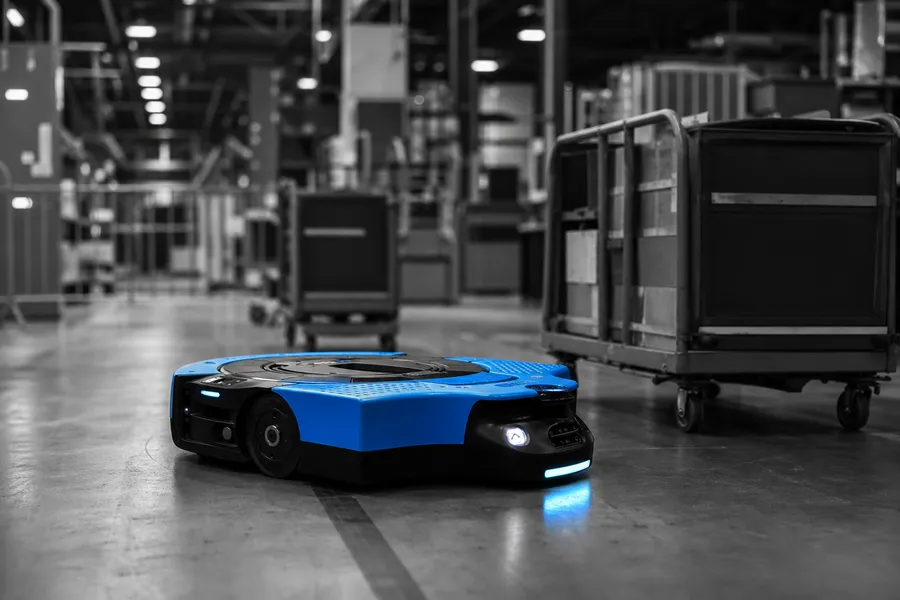
Amazon (AMZN.O) unveiled a natural-language warehouse robot at its Dartford event Thursday, deepening an automation push that has already eliminated 30,000 corporate roles and signals a structural shift in the company’s cost base.
For equity investors, the simultaneous acceleration of capital deployment into robotics and reduction of salaried headcount points to a meaningful long-run margin expansion story – though it also raises governance and regulatory risk that the market has yet to fully price.
Key Takeaways
- Next-gen Proteus robot accepts plain-language instructions; European rollout set for H1 2027.
- Amazon has cut 30,000 corporate employees since October 2025, citing AI efficiency.
- A $1 billion upskilling pledge accompanies a €10 billion European fulfillment investment.
Market Context & Competitive Positioning
Amazon’s robotics investment lands as peers including Walmart and UPS are under similar pressure to automate, meaning Thursday’s reveal is less a one-off product launch and more a sector-wide inflection signal. 1 Amazon already operates its existing Proteus model across 25 U.S. sites, though the current version is confined to dock areas; the next generation extends autonomous movement across entire warehouse floors.
The company also showcased Vulcan, its first touch-enabled robot capable of picking and stowing roughly 75% of stored items at speeds comparable to human workers, and STARK, a tote-handling system piloting in Barcelona that is slated for 15 European sites by 2027. 2 Taken together, the three systems represent a coordinated push to automate the full warehouse workflow, not isolated point solutions.
Detailed Analysis: The Workforce Equation
The new Proteus eliminates the technical barrier to human-robot interaction: workers direct it in plain speech, with no programming interface required. 2 That shift changes the skill profile for entry-level logistics roles from physical execution toward supervisory judgment – a transition most current job architectures and pay grades have not yet absorbed.
Amazon’s own data from a late-2024 Louisiana fulfillment center showed that advanced robotics deployment actually required 30% more employees in new categories, suggesting displacement and creation can coexist in the near term. 3 However, internal strategy documents reviewed by The New York Times indicate Amazon plans to automate 75% of operations by 2033, potentially avoiding the need to hire more than 600,000 workers over that horizon. 3
The corporate workforce reduction has been sharper and faster. Starting with roughly 14,000 white-collar cuts in October 2025, Amazon has shed approximately 30,000 corporate employees in eight months, representing close to 10% of its salaried staff. 4 A separate March 2026 round targeted at least 100 roles inside the robotics unit itself, including the cancellation of the Blue Jay multi-arm robotic project. 5
Three Amazon Web Services engineers appeared before Seattle’s Land Use and Sustainability Committee on the same day as Thursday’s robotics reveal, supporting a moratorium on new AI data-center construction. 2 “It’s been reported that this year Amazon is spending $200 billion on capital, with most of it going to data centers and AI,” AWS software engineer Patrick Schloesser told the committee. “Meanwhile, the leaders at my company have laid off 30,000 corporate employees in the last eight months.”
Management Position & Upskilling Commitment
Amazon VP of Robotics Scott Dresser framed the new Proteus in collaborative terms.
“You tell it what needs to be done. It figures out the priority, the route, the timing. It becomes your assistant for material movement,”
Dresser said at the Dartford event. 2
The company is pairing the robotics rollout with a $1 billion contribution to its Career Choice upskilling program – part of a broader $2.5 billion Future Ready 2030 pledge covering cybersecurity, mechatronics, and software development. 2 Amazon UK Country Manager John Boumphrey said the company intends to grow its European fulfillment workforce by 25,000 in coming years, though the timeline for those hires was not specified.
Regulatory & Investment Risk
Colorado’s Artificial Intelligence Act takes effect June 30, requiring employers to guard against algorithmic discrimination in employment decisions, including those shaped by robotic task-allocation systems. 2 The bipartisan AI Workforce PREPARE Act, if passed at the federal level, would additionally require companies to disclose when AI was a substantial factor in a mass layoff, creating a new disclosure obligation that investors should monitor.
CEO Andy Jassy has previously told employees that AI adoption is expected to reduce Amazon’s total corporate workforce in the near term, even as new role categories emerge – a forecast that, if realized, carries direct implications for operating leverage and longer-term revenue-per-employee metrics. 2
Conclusion
Amazon’s latest robotics suite – Proteus, Vulcan, and STARK – represents a technically coherent and commercially serious automation strategy, not a demonstration-stage prototype. The concurrent 30,000 corporate job reductions and €10 billion European infrastructure commitment confirm that the capital allocation shift is already underway, not merely projected.
Investors weighing AMZN.O exposure should track the pace of European Proteus deployment against the H1 2027 timeline, the scale-up rate of Career Choice relative to displaced roles, and developing federal AI-layoff disclosure legislation as a potential earnings-call variable from 2027 onward.
Not investment advice. For informational purposes only.
References
1(Oct 21, 2025). “Amazon’s Next Big Move: Replacing Over 500,000 Jobs With Robots”. GoElite. Retrieved June 5, 2026.
2Matthew Sellers (Jun 4, 2026). “Amazon launches worker robot that takes conversational instructions”. Human Resources Director. Retrieved June 5, 2026.
3(Oct 21, 2025). “Inside Amazon’s Plans to Replace Workers With Robots”. The New York Times. Retrieved June 5, 2026.
4WKMG News 6 ClickOrlando (Oct 28, 2025). “Amazon is implementing AI to downsize corporate ranks; 14,000 jobs cut”. YouTube / WKMG News 6. Retrieved June 5, 2026.
5Greg Bensinger (Mar 4, 2026). “Amazon Cuts More Jobs in Robotics Unit Amid Broader Layoffs”. Global Banking & Finance Review. Retrieved June 5, 2026.