
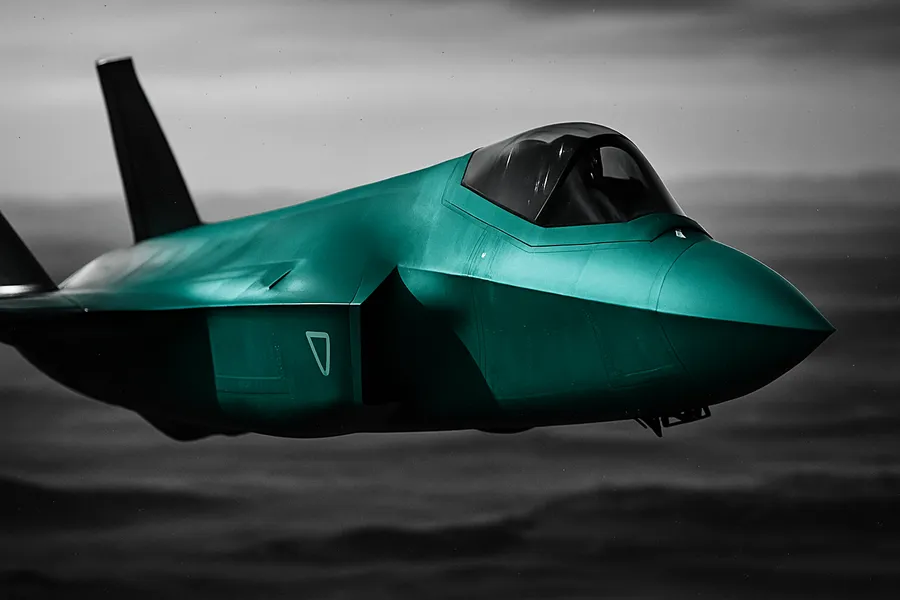
The Trump administration’s fiscal 2027 defense budget proposal seeks $1.5 trillion in spending, representing a substantial 66% increase that stands to benefit defense contractors such as Kratos Defense & Security Solutions, RTX Corp, and Lockheed Martin Corp. This historic funding surge marks the most significant defense spending expansion since World War II, supporting Trump’s vision for what he describes as a “dream military” in response to growing global security challenges.
Key Takeaways
- Trump requests record $1.5 trillion defense budget for 2027
- Space Force receives significant funding boost for rapid expansion
- Defense contractors positioned for major contract opportunities
Market Context and Congressional Support
The budget proposal would elevate defense spending to roughly 5% of GDP, aligning with NATO alliance standards. In a joint statement, Senate Armed Services Committee Chairman Roger Wicker and House Armed Services Committee Chairman Mike Rogers endorsed this commitment1.
“This substantial increase in defense spending is therefore both timely and essential,” the chairmen said. “Increased investment will lead to tangible hard power: accelerated shipbuilding and aircraft production, a modernized arsenal, and innovative technologies.”
Space Force Expansion Takes Center Stage
Officials within the Space Force expect considerable funding increases to facilitate rapid organizational development. Chief of Space Operations Gen. Chance Saltzman indicated the service must accelerate its expansion to address national security requirements2.
“Everybody’s recognized that we needed to grow and it looks like the resourcing is going to now match those aspirations,” Saltzman said during the Spacepower Security Forum. The Space Force has witnessed its satellite oversight responsibilities more than double since its creation, expanding from 225 to approximately 515 satellites.
Congressional Skepticism and Spending Challenges
While Republican leadership backs the proposal, the enormous spending increase encounters bipartisan concerns regarding fiscal viability. Rep. Adam Smith, the ranking Democrat on the House Armed Services Committee, questioned congressional approval prospects3.
“I don’t see a $1.5 trillion budget coming through this Congress,” Smith said at the McAleese Defense Programs Conference. “If it did, it would set us up for some pretty big failures down the road.”
Pentagon Readiness and Strategic Priorities
Pentagon comptroller Jules Hurst III verified that budget planners concentrated on “the most essential things” after eliminating numerous programs to achieve the $1.5 trillion target4. The budget emphasizes Reagan-era proportions through extensive investments in procurement and research development.
Acting Pentagon CFO Hurst noted the department possessed “more ideas and more concepts on how to spend the money” but streamlined proposals to prioritize critical capabilities. The budget focuses on drone dominance, space superiority, and advanced weapons systems including hypersonics and directed energy.
Industry Impact and Defense Modernization
The budget proposal comes as defense contractors experience pressure to fulfill existing contracts while expanding production capabilities. Trump’s simultaneous executive order threatens to limit corporate distributions for underperforming defense contractors, introducing accountability measures alongside increased spending5.
Major defense programs anticipated to receive benefits include the B-21 Raider bomber, F-47 Next-Generation Air Dominance fighter, and Golden Dome missile defense systems. The Space Force alone requires doubling its workforce and infrastructure to handle expanding mission requirements.
Outlook
Although the $1.5 trillion proposal represents Trump’s initial position, congressional appropriators will ultimately decide final spending levels. The budget’s emphasis on peer competitor threats from China, Russia, and Iran demonstrates shifting defense priorities from counterterrorism to great power competition.
Defense industry analysts interpret the proposal as confirmation of longstanding arguments for increased military modernization funding, while questions persist about the Pentagon’s ability to efficiently utilize such unprecedented amounts.
Not investment advice. For informational purposes only.
References
1House Armed Services Committee (January 8, 2026). “Chairmen of Senate and House Armed Services Committees Back President Trump’s $1.5 Trillion Defense Budget Topline Proposal”. Retrieved April 3, 2026.
2Anastasia Obis (April 1, 2026). “Fiscal 2027 budget request expected to back Space Force’s push for rapid growth”. Federal News Network. Retrieved April 3, 2026.
3Ashley Roque and Valerie Insinna (March 18, 2026). “With the Pentagon’s FY27 budget request forthcoming, it’s unclear if it will hit $1.5 trillion”. Breaking Defense. Retrieved April 3, 2026.
4Lauren C. Williams (March 17, 2026). “Record-smashing $1.5-trillion spending proposal will fund only the ‘most essential things’: comptroller”. Defense One. Retrieved April 3, 2026.
5Erin D. Dumbacher, Michael C. Horowitz, and Lauren Kahn (January 9, 2026). “Trump’s $1.5 Trillion Defense Budget Should Not Come as a Surprise”. Council on Foreign Relations. Retrieved April 3, 2026.