
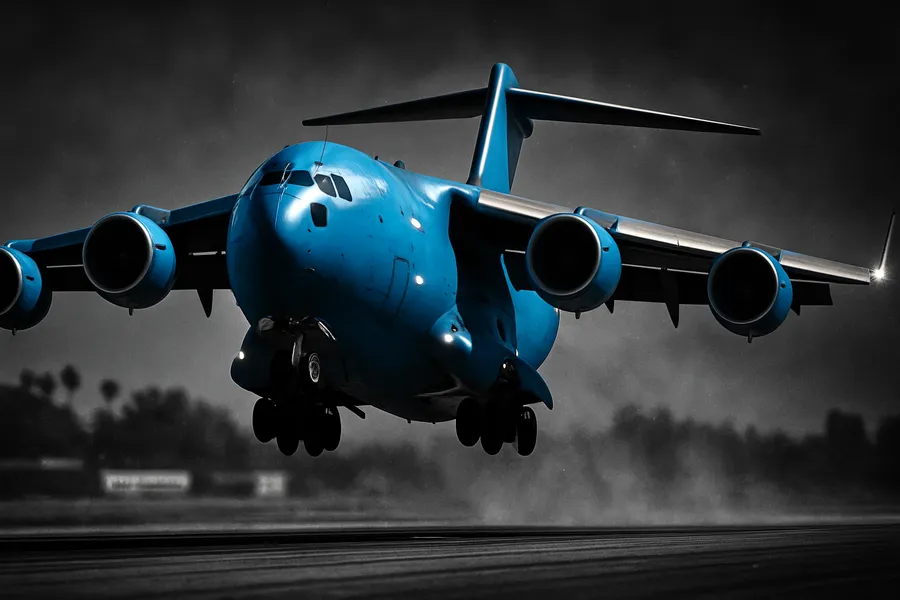
U.S. Air Force Vice Chief of Staff Gen. John Lamontagne told lawmakers Boeing (BA) must resolve ongoing KC-46 tanker problems before the military orders more aircraft. The mandate comes as Boeing faces billions in cost overruns and delivery pauses due to structural defects in the aerial refueling platform.
Key Takeaways
- Air Force halts new KC-46 orders until Boeing fixes problems
- Boeing suffered $2 billion in KC-46 losses during 2024
- Delivery pause follows cracks found in production aircraft
Program Setbacks Mount
The Air Force paused KC-46 deliveries in February after discovering cracks in the “outboard fixed-trailing-edge support structure” of two aircraft awaiting handoff 1. The damage does not pose immediate safety concerns but must be repaired before aircraft return to service.
Boeing has absorbed $2 billion in losses on the KC-46 program in 2024 alone under its fixed-price contract, which holds the company responsible for cost overruns above certain thresholds 1. The tanker has experienced numerous technical issues and schedule delays throughout its development.
Technical Challenges Persist
The KC-46’s most significant problem involves its Remote Vision System, a collection of sensors allowing boom operators to refuel receiver aircraft without visual confirmation. Boeing’s redesigned system is expected to be fielded in 2026 after years of delays.
The Air Force last paused deliveries for two months beginning in March 2024 due to a broken boom component, and later identified a new “category 1” deficiency involving fuel pump vibrations damaging bleed air ducts 1. Sources familiar with the current issue said cracks were found on aileron hinges of brand-new aircraft, a problem Boeing and the Air Force have monitored since 2018 on the commercial 767 platform.
Financial and Operational Impact
“We are working closely with the customer to assess a potential issue on KC-46 aircraft and to mitigate any potential impact to the fleet and in-production airplanes,” a Boeing spokesperson said 1. The company has not provided updated cost estimates for resolving the latest structural issues.
The Air Force’s stance reflects growing impatience with Boeing’s execution on major defense contracts. The KC-46 program exemplifies challenges facing defense contractors under fixed-price agreements, where cost overruns directly impact profitability rather than being passed to taxpayers.
Broader Context
Boeing’s defense division has faced scrutiny across multiple programs, including the 737 MAX commercial aircraft and various military projects. The KC-46 issues compound pressure on the company as it works to restore confidence among both commercial and military customers.
The Air Force’s conditional approach to future orders signals a shift toward holding contractors more accountable for performance before committing additional resources. This represents a departure from traditional defense procurement practices where programs often continued despite technical setbacks.
Outlook
Boeing must demonstrate successful resolution of structural and systems issues before the Air Force considers expanding the KC-46 fleet. The company’s ability to deliver reliable tankers affects U.S. military readiness and Boeing’s defense revenue stream.
The timeline for resolving current issues remains unclear, though Boeing and Air Force officials are working to identify root causes and develop both near-term fixes and long-term solutions for the troubled program.
Not investment advice. For informational purposes only.
References
1Valerie Insinna and Michael Marrow (March 3, 2025). “Air Force pauses deliveries of Boeing’s KC-46 tanker”. Breaking Defense. Retrieved March 12, 2026.
2Sheryl Tian Tong Lee (March 1, 2025). “US Air Force Checks Tanker Fleet After New Jets’ Damage: Report”. Bloomberg Government. Retrieved March 12, 2026.
3Tony Capaccio Bloomberg News (January 19, 2020). “Air Force warns Boeing’s new CEO that it’s not happy either”. Yakima Herald-Republic. Retrieved March 12, 2026.