
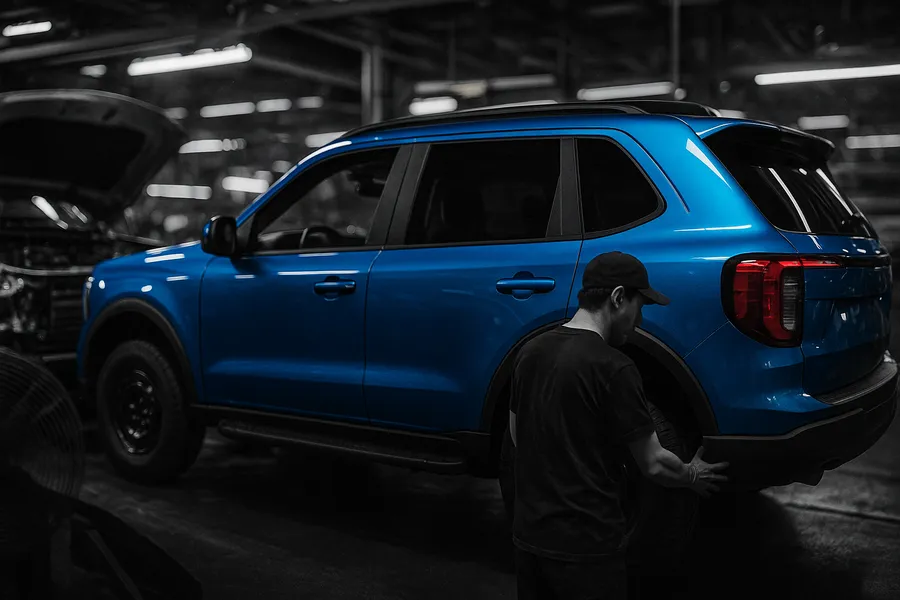
Ford Motor Company (F) and General Motors (GM) confront mounting pressure from Chinese electric vehicle manufacturers that risk making legacy automakers obsolete without rapid technological adaptation. The threat comes as Chinese EV giants like BYD leverage superior battery technology and lower production costs to challenge traditional automakers globally.
Key Takeaways
- Chinese EVs priced 25-30% below comparable U.S. models
- Ford reports $19.5 billion write-off on electric programs
- Industry faces regulatory whiplash amid policy reversals
Market Context and Financial Impact
Ford shares have declined nearly 5% in recent trading as investors digest the company’s massive $19.5 billion write-off on electric vehicle programs1. GM stock has also faced pressure, down over 1%, as both automakers grapple with the shifting competitive landscape.
The financial strain reflects broader industry challenges, with Ford losing $64,731 on each electric car sold last year, totaling $4.7 billion in EV losses2. These losses come as Chinese manufacturers like BYD can sell EVs for under $12,000, creating significant price competition.
Chinese Competition Intensifies
Chinese automakers have fundamentally altered the global automotive landscape since the pandemic. BYD surpassed Tesla as the world’s largest EV producer last year, leveraging China’s battery supply chain dominance and manufacturing expertise3.
The price differential remains stark, with Chinese EVs typically costing 5-10% less than gasoline models in China, while American EVs still cost 25-30% more than comparable internal combustion vehicles4. This cost advantage persists even after factoring in the 25% U.S. tariff on Chinese car imports.
Strategic Pivot and Regulatory Challenges
Ford CEO Jim Farley acknowledged the challenging reality, stating: “We can’t allocate money for things that will not make money. As much as I love those products, the customers in the U.S. were not going to pay for them”5.
The automaker is pivoting its strategy, converting its planned Blue Oval City electric truck facility in Tennessee to produce traditional internal combustion engines instead. Ford has also canceled several EV programs, including a second-generation Lightning pickup and Transit-style van.
Industry-Wide Transformation
The challenges extend beyond Ford and GM, with rapid policy shifts creating additional uncertainty. The Biden administration’s push for 56% EV adoption by 2032 has given way to the Trump administration’s rollback of emission standards and EV incentives6.
Despite the setbacks, automakers maintain they aren’t abandoning electric vehicles entirely. Ford plans to introduce a $30,000 electric pickup by 2027 using its new Universal EV Platform designed to reduce costs significantly7.
Future Outlook
The competitive threat from Chinese manufacturers appears likely to intensify, with companies like BYD exploring manufacturing facilities in Mexico that could provide easier access to North American markets8. This geographic expansion strategy mirrors historical patterns, such as Toyota’s successful entry into the U.S. market decades ago.
Industry analysts warn that domestic automakers risk losing their competitive edge if they fail to match the pace of innovation and cost reduction achieved by Chinese competitors. The next few years will prove critical in determining whether traditional American automakers can successfully navigate this technological and competitive transition.
Not investment advice. For informational purposes only.
References
1Automakers Are Facing an Expensive EV Dilemma amid Erratic Federal Rules. Car and Driver. Retrieved March 3, 2026.
2Robinson Meyer (February 16, 2024). “Why Ford and GM Are Scared of China’s BYD”. Heatmap News. Retrieved March 3, 2026.
3Robinson Meyer (February 16, 2024). “Why Ford and GM Are Scared of China’s BYD”. Heatmap News. Retrieved March 3, 2026.
4Robinson Meyer (February 16, 2024). “Why Ford and GM Are Scared of China’s BYD”. Heatmap News. Retrieved March 3, 2026.
5Automakers Are Facing an Expensive EV Dilemma amid Erratic Federal Rules. Car and Driver. Retrieved March 3, 2026.
6Automakers Are Facing an Expensive EV Dilemma amid Erratic Federal Rules. Car and Driver. Retrieved March 3, 2026.
7Automakers Are Facing an Expensive EV Dilemma amid Erratic Federal Rules. Car and Driver. Retrieved March 3, 2026.
8Robinson Meyer (February 16, 2024). “Why Ford and GM Are Scared of China’s BYD”. Heatmap News. Retrieved March 3, 2026.